
Disability hiring quota in the contact center: turning an obligation into real inclusion
Article 93 of Brazil's Lei 8.213/91 reserves 2% to 5% of jobs for people with disabilities. Here is how a contact center can meet it with accessibility and careers.
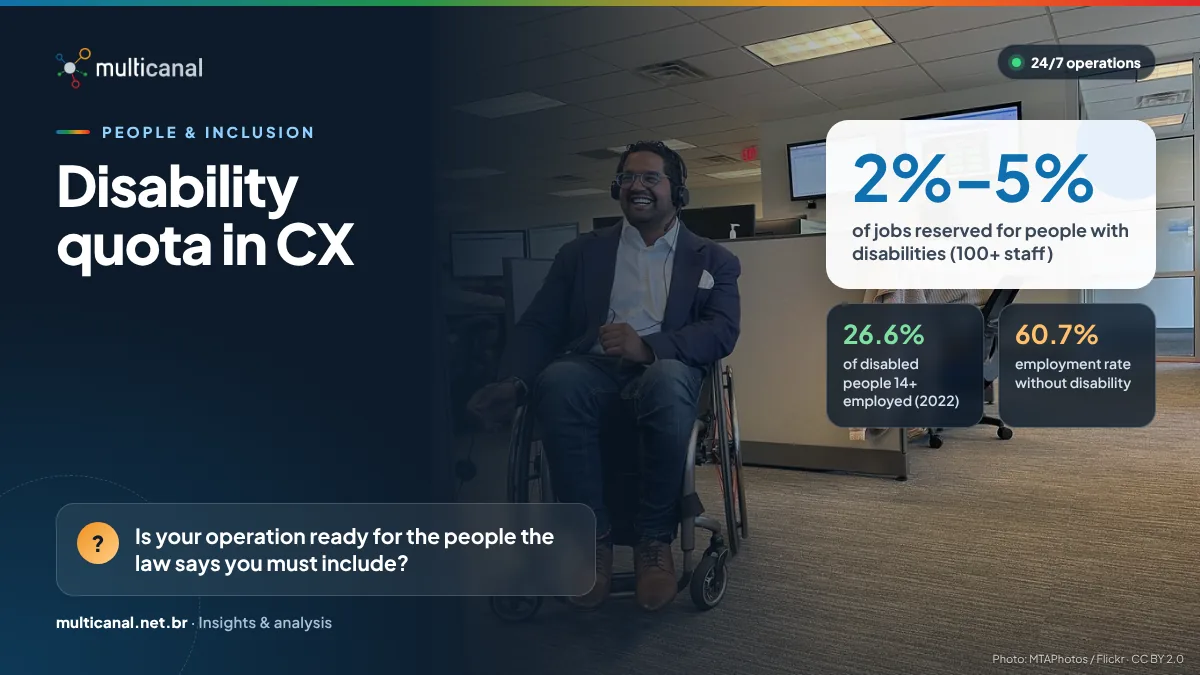
For 35 years, article 93 of Lei 8.213/1991 (Brazil’s Social Security Benefits Law) has reserved jobs for people with disabilities and workers rehabilitated by Social Security in companies with 100 or more employees, yet inclusion is still often treated as a number for labor inspectors. In a contact center, where work relies on communication, systems and adjustable workstations, the quota can be a steady source of talent — as long as the operation is designed to welcome it.
What the law requires, plainly
The rule scales with total headcount: 2% up to 200 employees, 3% from 201 to 500, 4% from 501 to 1,000 and 5% from 1,001 upward. Two details in the same article are often overlooked:
- Replacement before dismissal: dismissing a person with a disability or a rehabilitated worker without cause — or ending a fixed-term contract longer than 90 days — is only allowed after hiring another worker in the same condition (§ 1).
- Apprentices do not count: only direct hiring counts toward the quota; apprentices with disabilities are excluded from the calculation (§ 3).
Lei 13.146/2015, the Brazilian Inclusion Law (LBI), requires organizations of any kind to provide accessible and inclusive workplaces and forbids discrimination in hiring, retention and promotion, including demanding “full fitness” (art. 34). In public contracts, Lei 14.133/2021 (Brazil’s Public Procurement Law) requires bidders to declare compliance with the quota (art. 63, IV), keep it throughout the contract (art. 116), and allows termination if it is breached (art. 137, IX).
Why the contact center is fertile ground — and where it usually stumbles
Customer service combines tasks that can be adapted with well-known resources: screen readers and magnifiers, alternative keyboards and mice, suitable headsets, adjustable furniture and written channels such as chat, email and WhatsApp. The LBI calls this competitive placement with accessibility, assistive technology and reasonable accommodation (art. 37). The most common stumbles are not in the person but in the process: CRM or dialer software incompatible with screen readers, targets applied without adjustment, inaccessible training and leaders unprepared to handle accommodations.
A practical roadmap for a quota that lasts
- Describe the role by what it really requires — communication, reasoning, use of systems — rather than generic requirements that exclude for no reason.
- Test system accessibility before opening the position, with people who use assistive technology every day.
- Document each person’s reasonable accommodation (workstation, hours, tools, channel) and review it whenever the operation changes.
- Make onboarding accessible (screen-reader-friendly materials, captioned videos, Libras — Brazilian Sign Language — when needed) and prepare leaders to remove attitudinal barriers — the LBI guarantees accessibility in training courses (art. 34, § 5).
- Track retention and careers: turnover, promotions and reasons for leaving say more about inclusion than the quota percentage.
At Multicanal, disability inclusion is an ongoing program, alongside the Young Apprentice program, and our compliance channel accepts anonymous reports, with no retaliation — including reports of discrimination.
IBGE’s 2022 Continuous PNAD survey identified people with disabilities using the Washington Group (UN) questions, which measure difficulty in everyday activities rather than diagnoses alone: there were 18.6 million people aged 2 or older with a disability in Brazil, 8.9% of that population.
References and legislation
- Lei 8.213/1991, art. 93 · Brazilian job quota for people with disabilities and rehabilitated workers (updated text, in Portuguese) — access
- Lei 13.146/2015 (LBI) · Brazilian Inclusion Law, right to work (arts. 34–38, in Portuguese) — access
- Lei 14.133/2021 · Brazil’s Public Procurement Law, quota rules in bids and contracts (arts. 63, 116, 137) — access
- IBGE — Continuous PNAD 2022 · Persons with Disabilities module, released 07/07/2023 (in Portuguese) — access
In our experience, the quota works when accessibility is built into the operation’s design before the job opening. Accessible systems, prepared leaders and a career path retain people better than one-off campaigns.
— Multicanal Content Team · Multicanal Contact CenterHow Multicanal helps: we run an ongoing inclusion program for people with disabilities and young apprentices, covering recruitment, adapted workstations and team follow-up.
Discover our inclusion programKeep reading
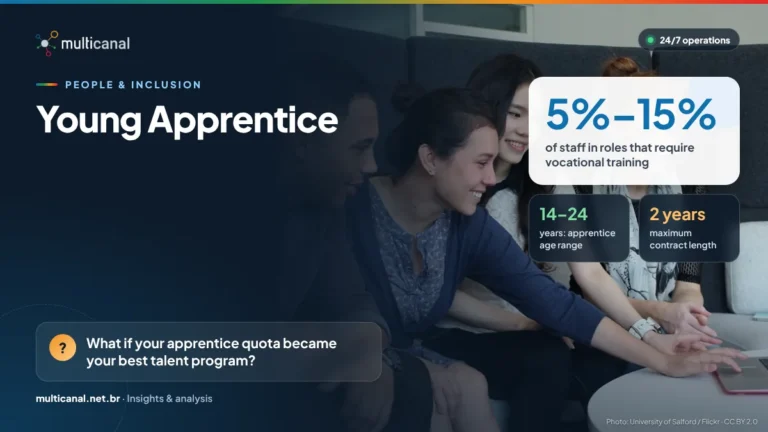
Young Apprentices in customer service: turning the quota into a career gateway
Brazil's labor code (CLT) requires 5% to 15% apprentices in roles that demand vocational training. See how a contact center turns this rule into talent development.
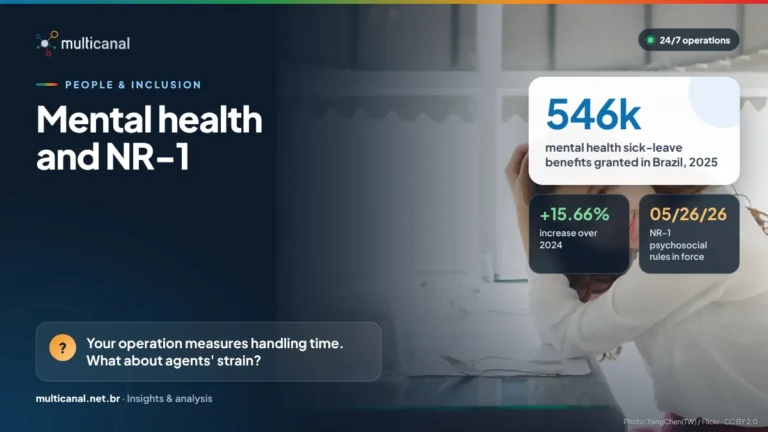
Agent mental health: what Brazil’s NR-1 now requires on psychosocial risks
Since May 26, 2026, risk management under Brazil's NR-1 includes psychosocial factors. See what changes in the contact center and how to move from diagnosis to…
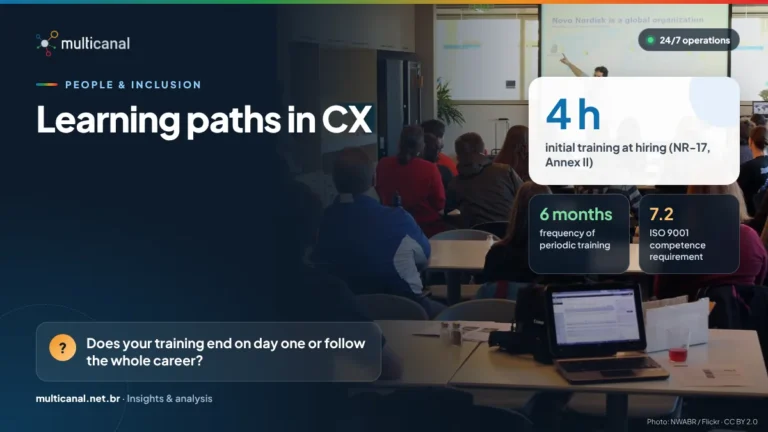
Customer service learning paths: from onboarding to leadership, without improvisation
Training in a contact center is not an event, it is a system. See the legal minimum under Brazil's NR-17 and how to build paths that…