
Customer service learning paths: from onboarding to leadership, without improvisation
Training in a contact center is not an event, it is a system. See the legal minimum under Brazil's NR-17 and how to build paths that take agents from day one to leadership.
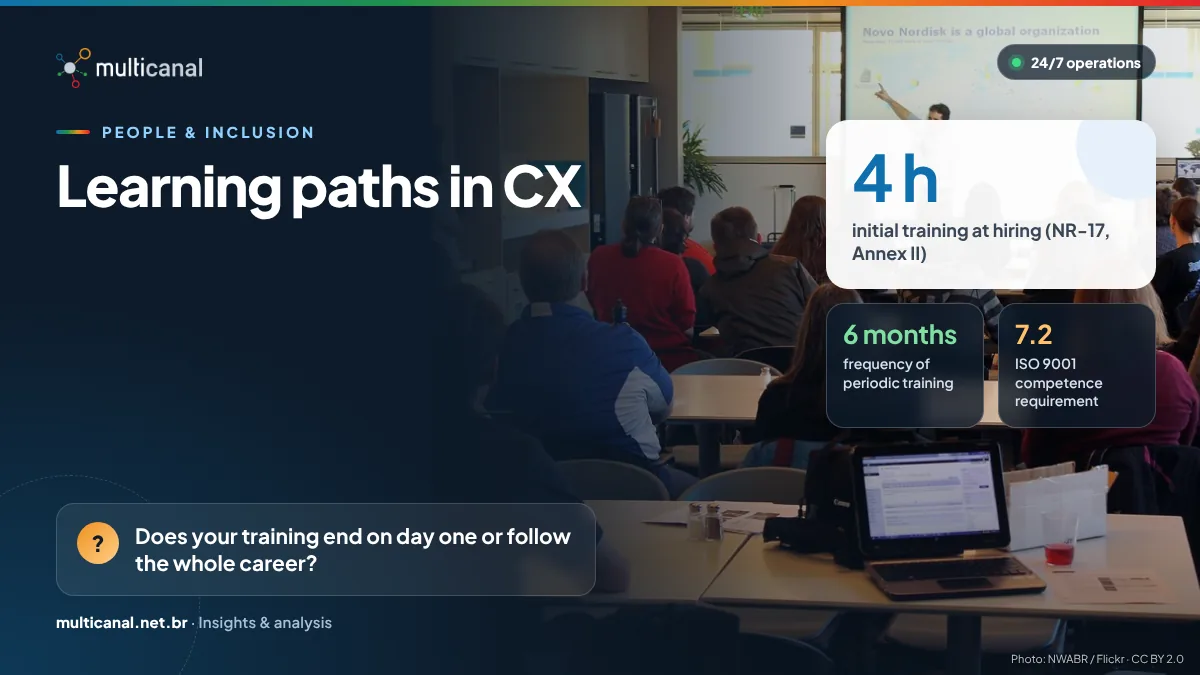
Turnover, new channels, product changes and rules such as Brazil’s Customer Service Decree make the contact center a place where knowledge ages fast. Training concentrated at hiring cannot keep up. The alternative is to think in learning paths: continuous journeys, with clear stages, that take professionals from their first day to the role of technical reference or team leader.
The legal minimum: what NR-17 already requires
Annex II of NR-17, Brazil’s ergonomics standard for call center work, requires that all operations and management staff — including temporary workers — be trained on risk factors, preventive measures, symptoms of illness (musculoskeletal, mental health, voice, hearing and vision) and correct use of furniture and equipment (item 7). Initial training lasts 4 hours at hiring and periodic training happens every 6 months, always during working hours and with course materials. There is also occasional training whenever new methods, equipment, types of service or management changes arise (item 7.2), and the time agents spend updating their knowledge counts as regular working time (item 6.5).
A four-stage path
- Onboarding: products and systems, conduct, information security and data protection (LGPD), ergonomics and the duties of Decree 13.135/2026 (Brazil’s new Customer Service Decree, in force since 11/02/2026), such as timeliness, privacy, resolution and service by a human being when requested (art. 4) and the ban on asking consumers to repeat a request already recorded (art. 6, II).
- Proficiency: active listening, writing for digital channels, difficult situations and use of the knowledge base, with coaching-oriented quality monitoring.
- Specialization: retention, collections and negotiation, second-level support, back office, quality or WFM, depending on profile and operational needs.
- Leadership: feedback, schedule and KPI management, harassment prevention and attention to psychosocial risks, now part of risk management under NR-1.
Each stage needs observable entry and exit criteria — internal certification, quality score, mastery of a channel — so that progression does not depend on personal impressions.
How to know whether the path works
ISO 9001 requires organizations to determine the competence needed by people who affect quality, take action to acquire it and evaluate the effectiveness of those actions (clause 7.2). ISO 10015:2019 provides guidelines for competence management and people development. In the operation, this becomes indicators such as time to proficiency, progress in quality monitoring, first contact resolution and recurrence of errors after each module — comparing cohorts rather than just adding up classroom hours.
ISO 10015, first published in 1999 as “Guidelines for training”, was revised in 2019 to cover competence management and people development — a sign that the focus shifted from course hours to demonstrated competence.
References and legislation
- NR-17, Annex II · call center/telemarketing work, item 7: training (in Portuguese) — access
- Decree 13.135/2026 · Brazil’s new Customer Service (SAC) rules, replacing Decree 11.034/2022 (in Portuguese) — access
- ISO 9001:2015 · quality management systems, requirements (competence, 7.2) — access
- ISO 10015:2019 · guidelines for competence management and people development — access
We have found that the most effective learning paths are born from quality monitoring: today’s recurring errors become tomorrow’s module. When training and quality talk to each other, learning stops being a fixed cost and starts solving real problems.
— Multicanal Content Team · Multicanal Contact CenterHow Multicanal helps: we provide customer service and IT training, backed by a quality management system that follows the standards of ISO 9001.
Discover our trainingKeep reading
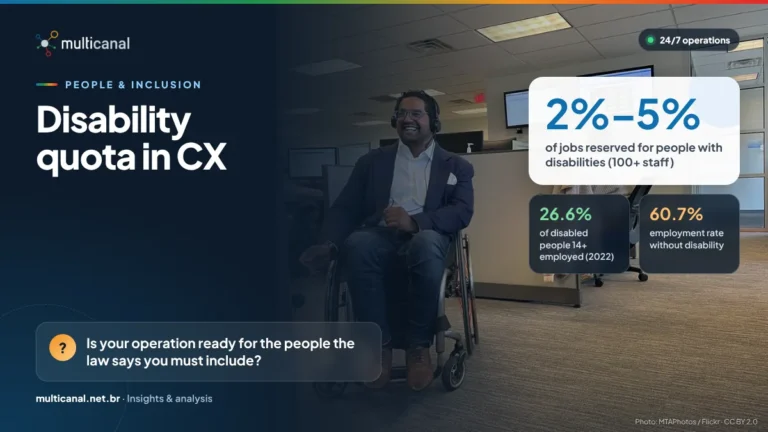
Disability hiring quota in the contact center: turning an obligation into real inclusion
Article 93 of Brazil's Lei 8.213/91 reserves 2% to 5% of jobs for people with disabilities. Here is how a contact center can meet it with…
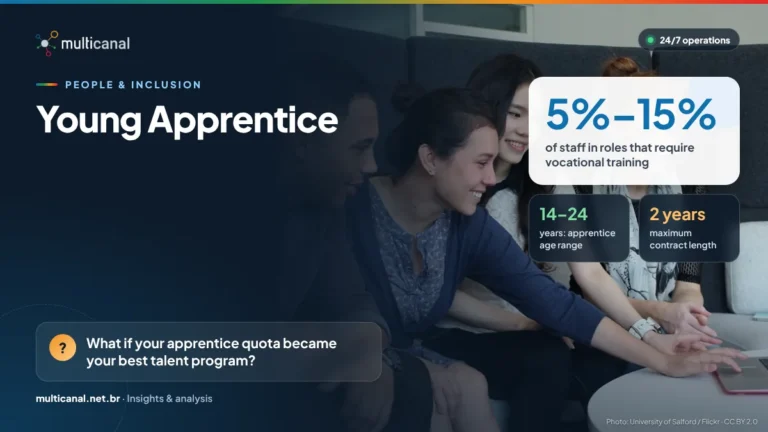
Young Apprentices in customer service: turning the quota into a career gateway
Brazil's labor code (CLT) requires 5% to 15% apprentices in roles that demand vocational training. See how a contact center turns this rule into talent development.
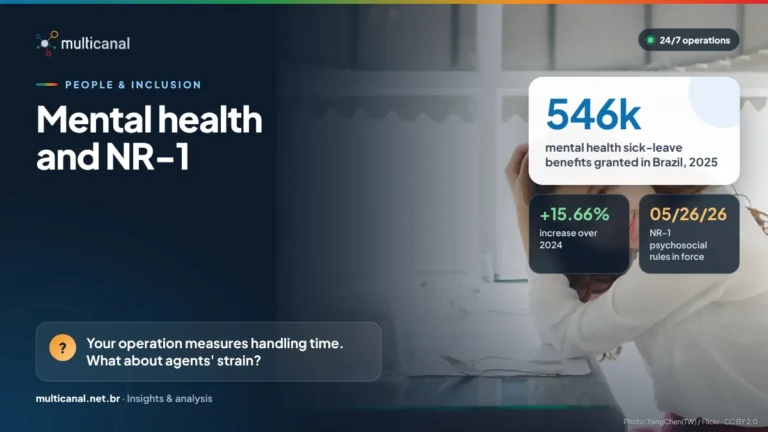
Agent mental health: what Brazil’s NR-1 now requires on psychosocial risks
Since May 26, 2026, risk management under Brazil's NR-1 includes psychosocial factors. See what changes in the contact center and how to move from diagnosis to…