
Accessible customer service: what Brazil’s LBI, Libras Law and SAC decree require
Channel accessibility is both a legal duty and a quality criterion. See what Brazil's Inclusion Law, Libras Law and Decree 13.135/2026 require and how to apply them.
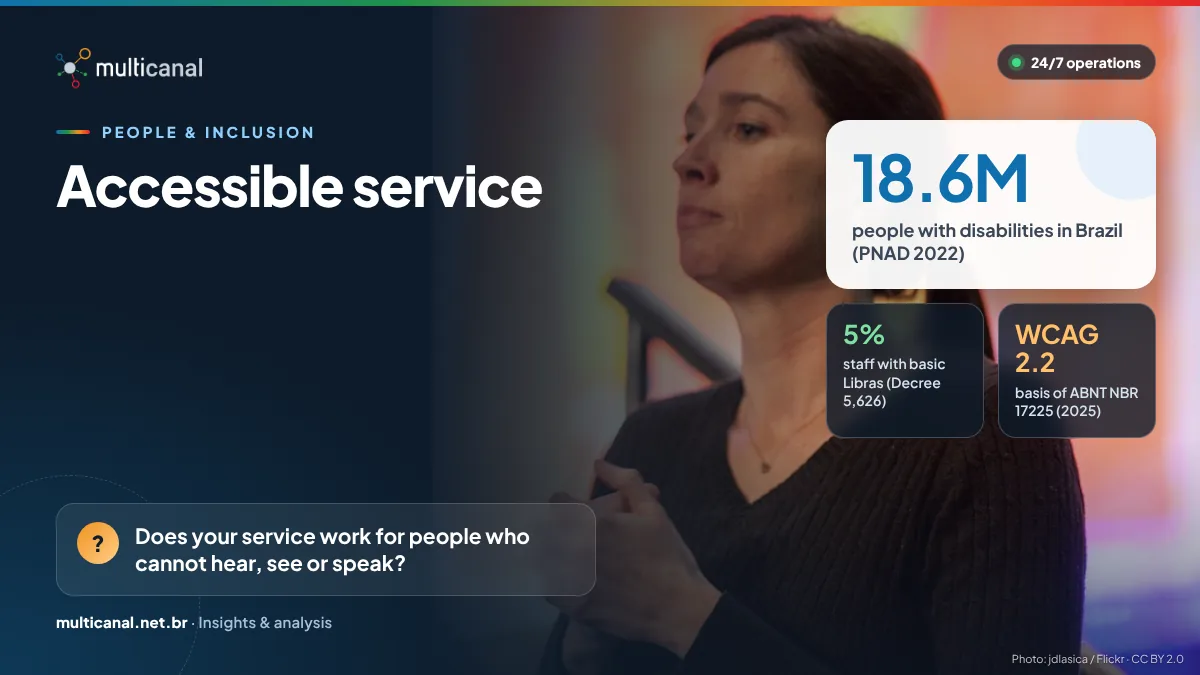
There are 18.6 million people with disabilities in Brazil, according to IBGE’s 2022 Continuous PNAD survey. For them, an IVR menu with no time to respond, a chat incompatible with screen readers or the lack of service in Libras (Brazilian Sign Language) are not inconveniences: they are closed doors. Channel accessibility is a legal obligation and, at the same time, a good test of service quality for everyone.
What the law requires
- Brazilian Inclusion Law (Lei 13.146/2015): defines accessibility as including information, communication, systems and technologies (art. 3, I); makes accessibility mandatory on websites of companies based or represented in Brazil and of government bodies, following international best practices (art. 63); and requires telecom providers to ensure full access for people with disabilities (art. 65).
- Decree 13.135/2026 (new customer service decree, in force since 11/02/2026): requires broad accessibility in the SAC channels of covered suppliers, with full access to their requests, with regulators detailing the rules (art. 10); older people receive priority treatment (art. 11).
- Lei 10.436/2002 and Decree 5.626/2005: Libras is a legal means of communication and expression; government, public service concessionaires and federal bodies must ensure service to deaf people, with at least 5% of staff trained in basic Libras and the use of interpreters or a relay center with videoconference and webchat (art. 26).
- Lei 13.460/2017: accessibility and courtesy are guidelines for serving users of public services, with legal priorities guaranteed (art. 5).
Channels for everyone, in practice
Accessibility is not a special channel but a property of every channel:
- Phone and IVR: short menus, enough time to choose, a clear option to talk to a person and agents prepared for callers with speech or intellectual disabilities.
- Chat and WhatsApp: plain language, messages that do not rely only on images or audio, and screen reader compatibility.
- Video: the new decree recognizes electronic channels by voice, text or video with real-time interaction (art. 3, § 2), a natural space for service in Libras.
- Website and app: compliance with W3C’s WCAG 2.2 and with ABNT NBR 17225, the Brazilian web accessibility standard launched in March 2025 and aligned with WCAG 2.2.
- Documents: bills, contracts and receipts in digital formats readable by assistive technologies.
How to start
Run a channel-by-channel assessment with people with disabilities, record the barriers, prioritize those that prevent a request from being completed and add accessibility to the acceptance criteria of any system or flow change. Train the team to offer the right channel without embarrassment and track resolution of these contacts as a quality indicator.
Lei 10.436/2002 recognized Libras as a legal means of communication and expression of deaf communities, but established that it does not replace written Portuguese (art. 4, sole paragraph) — which is why it pays to offer both Libras and written channels.
References and legislation
- Lei 13.146/2015 (LBI) · Brazilian Inclusion Law (arts. 3, 63 and 65, in Portuguese) — access
- Decree 13.135/2026 · new SAC rules, channel accessibility (art. 10, in Portuguese) — access
- Lei 10.436/2002 · recognizes Brazilian Sign Language (Libras) (in Portuguese) — access
- Decree 5.626/2005 · regulates the Libras Law (art. 26, public service, in Portuguese) — access
- WCAG 2.2 (W3C) · international web content accessibility guidelines — access
- ABNT NBR 17225 · launch of the Brazilian web accessibility standard (Agência Gov, 03/2025, in Portuguese) — access
We see that accessibility improves service for everyone: shorter menus, plain language and a clear option to talk to a person reduce friction for any customer. The key is testing with people who use assistive technology, not just with checklists.
— Multicanal Content Team · Multicanal Contact CenterHow Multicanal helps: we integrate voice, chat, WhatsApp and other channels on the OMNI CHANNEL platform and run an ongoing inclusion program for people with disabilities.
Discover our commitment to inclusionKeep reading
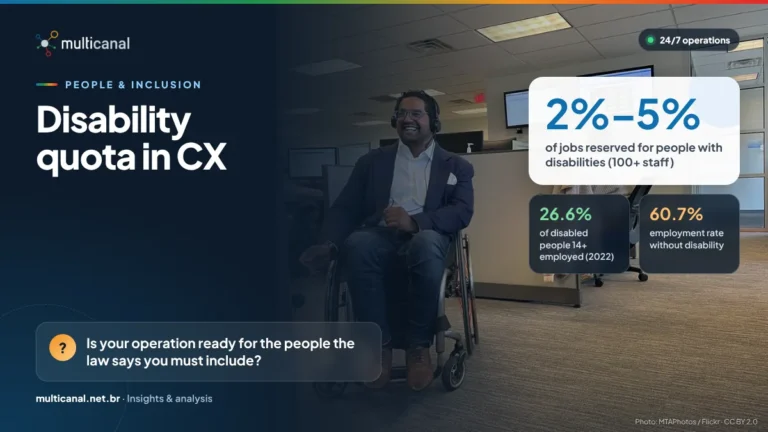
Disability hiring quota in the contact center: turning an obligation into real inclusion
Article 93 of Brazil's Lei 8.213/91 reserves 2% to 5% of jobs for people with disabilities. Here is how a contact center can meet it with…
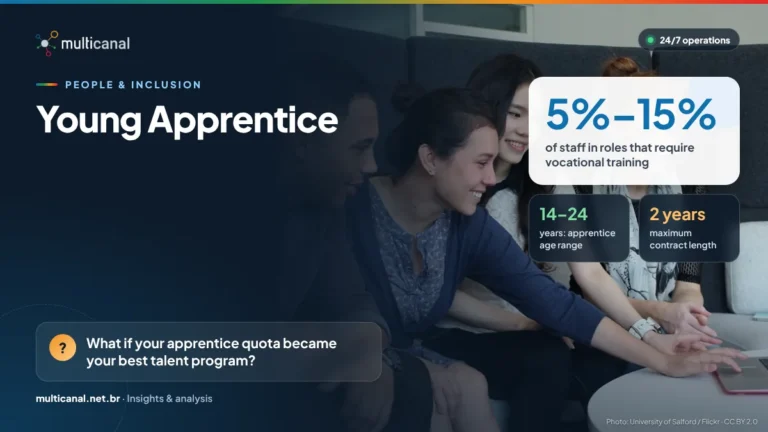
Young Apprentices in customer service: turning the quota into a career gateway
Brazil's labor code (CLT) requires 5% to 15% apprentices in roles that demand vocational training. See how a contact center turns this rule into talent development.
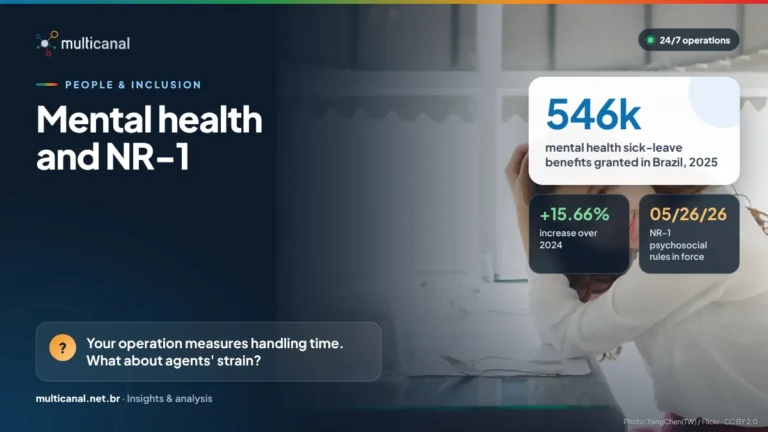
Agent mental health: what Brazil’s NR-1 now requires on psychosocial risks
Since May 26, 2026, risk management under Brazil's NR-1 includes psychosocial factors. See what changes in the contact center and how to move from diagnosis to…