
Knowledge base with KCS: how to cut repeat tickets at the service desk
When the same question is solved from scratch every day, the problem is knowledge. See how KCS turns each interaction into a useful, reusable article.
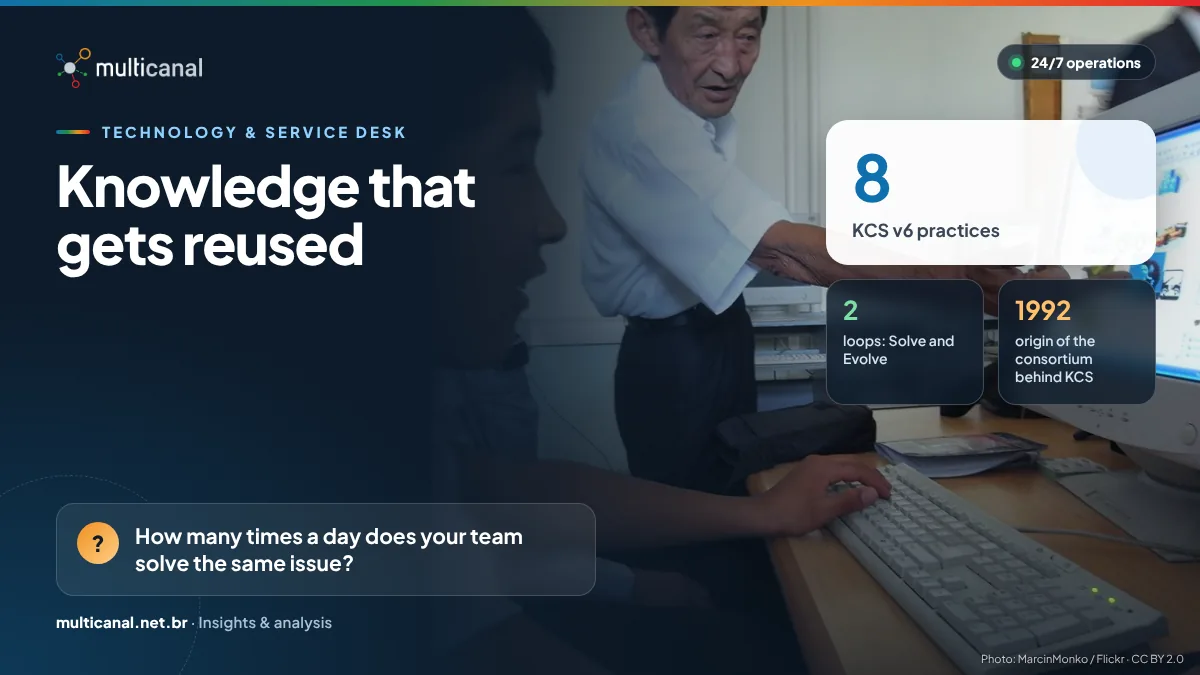
The same question arrives ten times a day, and each analyst answers it differently. The fix lives in the heads of two veterans, and the wiki was last updated months ago. This costs time, creates rework and makes support unpredictable. KCS proposes a simple reversal: knowledge is created and improved during the interaction itself, by the person who resolves the ticket.
What KCS is (and why it is not another wiki project)
KCS is a knowledge management methodology developed by the Consortium for Service Innovation, a non-profit alliance whose origins go back to 1992. The core idea is to treat knowledge as a natural by-product of work: instead of a separate team writing documentation, the people who handle tickets capture, use and fix articles within the ticket workflow. KCS v6, the most widely used reference version, organizes the method into eight practices spread across two complementary loops.
The Solve Loop: knowledge captured at the moment of support
- Capture: record the issue in the user’s words, in the context where it appears, while the interaction is happening.
- Structure: use a simple, consistent template — issue, environment, resolution and cause — so the article is easy to find and read.
- Reuse: “search early, search often”. Before investigating, the analyst searches the knowledge base and links the article used to the ticket.
- Improve: “reuse is review”. Whoever uses an article and spots a flaw fixes it on the spot or flags it to someone with permission — the “flag it or fix it” principle.
The Evolve Loop: from many interactions to better service
The second loop looks at the whole. It brings together the practices of content health, process integration, performance assessment, and leadership and communication. Day to day, this means analysing which articles are reused most and turning them into self-service or automation; taking recurring patterns to problem management, which seeks the root cause; and reviewing or archiving content nobody uses.
KCS also defines competency levels for those who write and publish, such as KCS Candidate, KCS Contributor and KCS Publisher. Publishing autonomy grows as analysts demonstrate quality, without creating an approval bottleneck.
How to start without disrupting operations
- Pick a pilot with a high-volume topic and an engaged team.
- Integrate the knowledge base with the ticketing tool: searching and linking must take seconds.
- Define what a “good enough” article to publish looks like and train coaches to support analysts.
- Track article linking, reuse and corrections. Avoid targets for the number of articles, which encourage duplicate content.
In 2026, the Consortium for Service Innovation announced that KCS, formerly known as Knowledge-Centered Service, has become Knowledge-Centered Success, extending the method beyond support. KCS v6 materials, training and certifications remain available during the transition.
References and legislation
- KCS v6 Practices Guide · official guide to the eight practices and the Solve and Evolve loops — access
- From Service to Success: KCS is Evolving · announcement of the new phase of KCS (2026) — access
- Innovating Together For 30 Years · history of the Consortium for Service Innovation — access
The best article is usually written by whoever has just resolved the ticket. We prefer to start small, with a high-volume topic, and let reuse show what deserves to become self-service.
— Multicanal Content Team · Multicanal Contact CenterHow Multicanal helps: in help desk and service desk operations, Multicanal helps structure the knowledge base, the support scripts and the operational reports that reveal where repeat issues are.
Explore our service deskKeep reading
Service desk with ITIL 4 and ISO/IEC 20000-1: how to design SLAs that are actually met
A good SLA is one users can feel. Learn how to combine ITIL 4 practices with ISO/IEC 20000-1 requirements to build realistic, measured and improving agreements.
Tier 1, 2 and 3 support: how to structure levels and escalation rules
Tickets bouncing between teams are a sign of poorly defined levels. See the role of each tier, how to escalate with clear criteria and how to…
Secure cloud: ISO/IEC 27017 and 27018 in practice for cloud service customers
Moving systems to the cloud does not transfer responsibility for the data. See what ISO/IEC 27017 and 27018 recommend and what cloud customers need to demand…