
Secure cloud: ISO/IEC 27017 and 27018 in practice for cloud service customers
Moving systems to the cloud does not transfer responsibility for the data. See what ISO/IEC 27017 and 27018 recommend and what cloud customers need to demand and do.
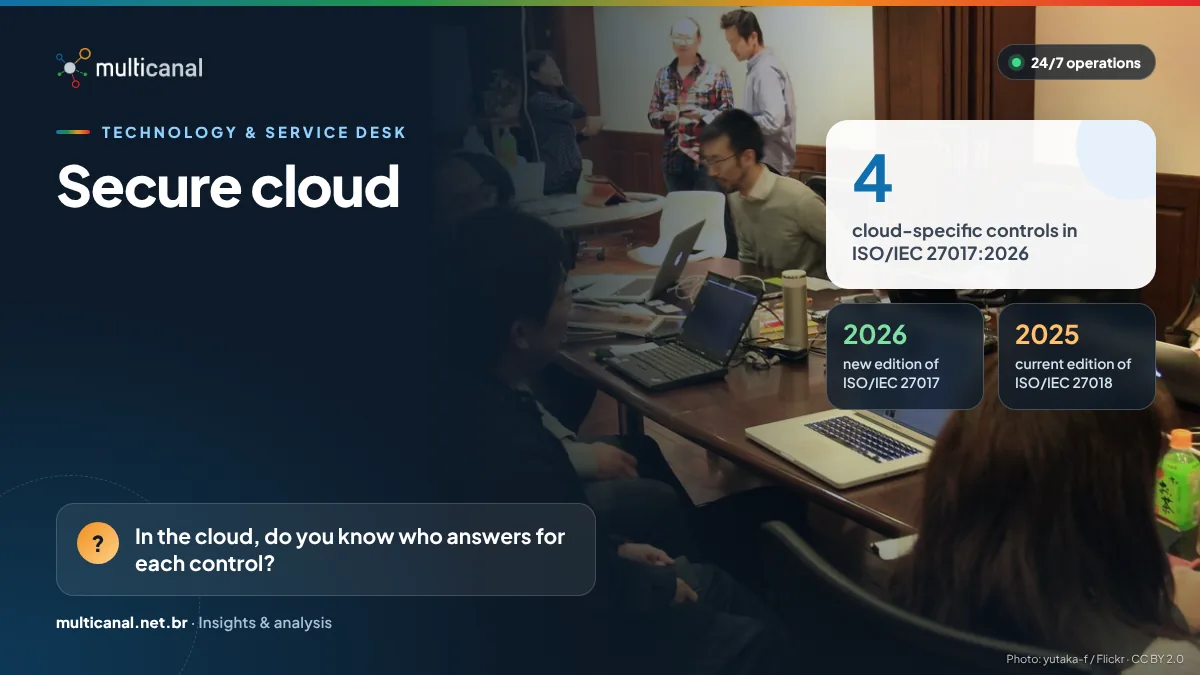
Contact center platforms, CRM, call recordings and transcripts increasingly live in the cloud. The move brings scale and availability, but it does not transfer responsibility: if data leaks because of a poor configuration, the problem still belongs to whoever contracted the service. This is where two international standards designed for the cloud come in: ISO/IEC 27017 and ISO/IEC 27018.
What each standard covers
ISO/IEC 27017 provides information security controls for cloud services based on ISO/IEC 27002, with guidance for both the cloud service customer (CSC) and the cloud service provider (CSP), in any deployment model. The second edition, ISO/IEC 27017:2026, published in July 2026, replaced the 2015 edition and was aligned with ISO/IEC 27002:2022. It concentrates cloud-specific topics into four controls: shared roles and responsibilities in the cloud environment, roles of cloud service partners, segregation in virtual environments, and detection and prevention of unauthorized use of cloud services.
ISO/IEC 27018:2025, the third edition, published in August 2025, addresses the protection of personal data (PII) in public clouds acting as PII processors. It follows the privacy principles of ISO/IEC 29100 and builds on ISO/IEC 27002:2022.
Shared responsibility, from the customer’s side
- Responsibility matrix: who patches, backs up, manages identities, keeps logs and responds to incidents — at each layer of the contracted service.
- Contract: storage location, sub-processors, incident notification deadlines, retention, and return or deletion of data at the end of the relationship.
- Identity and access: multi-factor authentication, least-privilege profiles by role and strict control of administrative accounts.
- Configuration and monitoring: periodic configuration reviews, preserved access logs and alerts for unusual use.
- Encryption and keys: data encrypted in transit and at rest, with clear rules on who controls the keys.
- Exit plan: ISO/IEC 27001:2022 requires processes for the acquisition, use, management and also exit from cloud services (control 5.23).
LGPD: the provider is a processor, but responsibility does not disappear
Under Brazil’s data protection law (LGPD, Law 13.709/2018), the processor handles data according to the controller’s instructions, and the controller must check that they are followed (art. 39). Security measures apply from the design of the service (art. 46), and incidents that may cause relevant risk or harm must be reported to the ANPD and to data subjects (art. 48) — within three business days under ANPD Resolution CD/ANPD No. 15/2024. If data is stored abroad, the international transfer must rely on one of the mechanisms in art. 33, regulated by Resolution CD/ANPD No. 19/2024, which includes standard contractual clauses.
ISO/IEC 27017 was born from joint work between ISO/IEC and the International Telecommunication Union: the text of the 2015 edition was published identically as Recommendation ITU-T X.1631.
References and legislation
- ISO/IEC 27017:2026 · security controls for cloud services (IEC Webstore) — access
- ISO/IEC 27018:2025 · protection of PII in public clouds (IEC Webstore) — access
- ISO/IEC 27001:2022 · information security management systems — access
- Lei 13.709/2018 (LGPD) · Brazil’s data protection law, arts. 33, 39, 46 and 48 (in Portuguese) — access
- ANPD regulations · including Resolutions CD/ANPD No. 15/2024 and No. 19/2024 (in Portuguese) — access
The platforms we use run on infrastructure from partners and cloud providers. So, as cloud customers, the question we ask is not just “is the provider secure?” but “who does what, and how do we prove it?”.
— Multicanal Content Team · Multicanal Contact CenterHow Multicanal helps: Multicanal follows the standards of ISO/IEC 27001 and 27701 and adopts practices aligned with ISO/IEC 27017 and 27018 in managing the cloud services it contracts for its operations.
See the standards we followKeep reading
Service desk with ITIL 4 and ISO/IEC 20000-1: how to design SLAs that are actually met
A good SLA is one users can feel. Learn how to combine ITIL 4 practices with ISO/IEC 20000-1 requirements to build realistic, measured and improving agreements.
Knowledge base with KCS: how to cut repeat tickets at the service desk
When the same question is solved from scratch every day, the problem is knowledge. See how KCS turns each interaction into a useful, reusable article.
Tier 1, 2 and 3 support: how to structure levels and escalation rules
Tickets bouncing between teams are a sign of poorly defined levels. See the role of each tier, how to escalate with clear criteria and how to…