
Service desk with ITIL 4 and ISO/IEC 20000-1: how to design SLAs that are actually met
A good SLA is one users can feel. Learn how to combine ITIL 4 practices with ISO/IEC 20000-1 requirements to build realistic, measured and improving agreements.
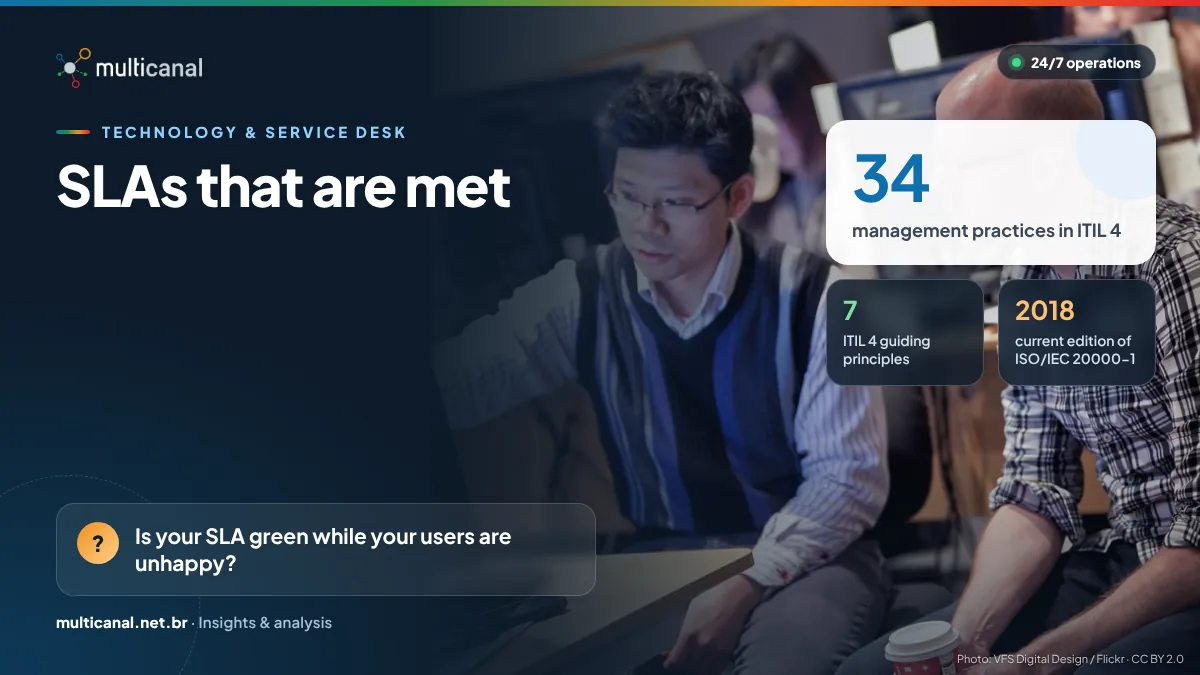
Green dashboard, frustrated users. This mismatch — the so-called watermelon effect, green on the outside and red on the inside — appears when the SLA measures what is easy rather than what matters to the people who depend on IT. Combining ITIL 4 practices with the requirements of ISO/IEC 20000-1 is the safest route to service level agreements that are realistic, measured and continually improved.
ITIL 4 and ISO/IEC 20000-1: different roles, same goal
ITIL 4, published in 2019 and now maintained by PeopleCert, is a body of good practice. It organizes service management into a service value system with seven guiding principles — such as “focus on value” and “start where you are” — and 34 practices, including service desk, incident management and service level management. In 2026 PeopleCert began the phased rollout of ITIL (Version 5); ITIL 4 remains available and existing certifications keep their value.
ISO/IEC 20000-1:2018 is the international standard that sets requirements for a service management system (SMS). It defines what must exist — planning, a catalogue, service level agreements, incident and request management, improvement — and it can be audited. ITIL helps decide how to do it. In practice, each supports the other.
From catalogue to SLA: the sequence that avoids impossible promises
- Service catalogue: what the service desk supports, for whom, through which channels and during which hours (8×5, 12×6 or 24×7).
- Priority by impact and urgency: response and resolution targets set per priority level, not a single number for everything.
- An incident is not a request: restoring an interrupted service and fulfilling a standard request (access, password, installation) need different flows and targets.
- Internal agreements (OLAs) and suppliers: the customer SLA can only be met if second- and third-level teams and underpinning contracts have compatible targets.
- Clock rules: when the clock stops (waiting for the user or a third party), how holidays count and what closes a ticket — all written down beforehand, not negotiated afterwards.
Measure what matters (and escape the watermelon effect)
The classic metrics are still useful: time to first response, resolution time by priority, percentage within SLA, backlog by age, reopen rate and first contact resolution. The mistake is to look only at them. Cross time with post-contact satisfaction, recurrence and business impact, and take deviations to problem management, which tackles causes rather than symptoms.
Close the loop with regular service level reviews with the customer: what was delivered, what changed in demand and what will be adjusted. Continual improvement is a component of the ITIL 4 service value system and a requirement of ISO/IEC 20000-1 — and it is what turns the SLA from a contract clause into a management tool.
When the SLA becomes a payment clause
In public and private contracts, service levels are often tied to deductions, penalties or bonuses. That is why each metric needs an agreed definition, data source, formula and frequency, with reports that can be checked. An SLA that cannot be measured independently becomes a dispute, not management.
ITIL certifies people, not companies. For an organization to formally demonstrate its service management system, the route is an ISO/IEC 20000-1 certification audit carried out by a certification body.
References and legislation
- ISO/IEC 20000-1:2018 · requirements for service management systems (confirmed in 2023; Amendment 1:2024) — access
- ITIL (Version 5) explained — PeopleCert · how ITIL is evolving and the status of ITIL 4 — access
In our view, an SLA that is met starts with a clear catalogue, priorities agreed with the customer and OLAs with the people who actually fix things. Time and satisfaction must be tracked side by side, because one without the other tells only half the story.
— Multicanal Content Team · Multicanal Contact CenterHow Multicanal helps: Multicanal runs help desk and service desk operations 24/7, with practices aligned with ITIL and ISO/IEC 20000-1, operational reports and metrics defined with each client.
Explore our service deskKeep reading
Knowledge base with KCS: how to cut repeat tickets at the service desk
When the same question is solved from scratch every day, the problem is knowledge. See how KCS turns each interaction into a useful, reusable article.
Tier 1, 2 and 3 support: how to structure levels and escalation rules
Tickets bouncing between teams are a sign of poorly defined levels. See the role of each tier, how to escalate with clear criteria and how to…
Secure cloud: ISO/IEC 27017 and 27018 in practice for cloud service customers
Moving systems to the cloud does not transfer responsibility for the data. See what ISO/IEC 27017 and 27018 recommend and what cloud customers need to demand…