
Retention and after-sales: the contact center as a revenue center
Retaining customers and selling after the sale takes balance: relevant offers, without making cancellation harder. See how to structure the operation within the rules.
The contact center is often seen as a cost. But it is where customers say they are leaving, explain what did not work and often accept a better solution. Done well, retention and after-sales generate revenue; done poorly, they become a barrier to cancellation, complaints and fines. The difference lies in how the operation is designed.
Retention: listen before you offer
A good retention team starts by understanding the reason for the request. Price, technical failure, changing needs and poor service call for different answers, and not every customer should be retained at any cost. Some practical tips:
- classify cancellation reasons and fix root causes;
- offer alternatives tied to the reason, such as a plan adjustment, a technical fix or a commercial condition, without insisting;
- give agents autonomy within clear rules, so they can resolve on first contact;
- record the offer made and the customer’s answer, for auditing and continuous improvement;
- measure retention that holds in the following months, not just on the day.
Staffing the team properly also matters: a long wait at the very moment the customer wants to leave tends to deepen dissatisfaction.
The legal limit: cancellation cannot be obstructed
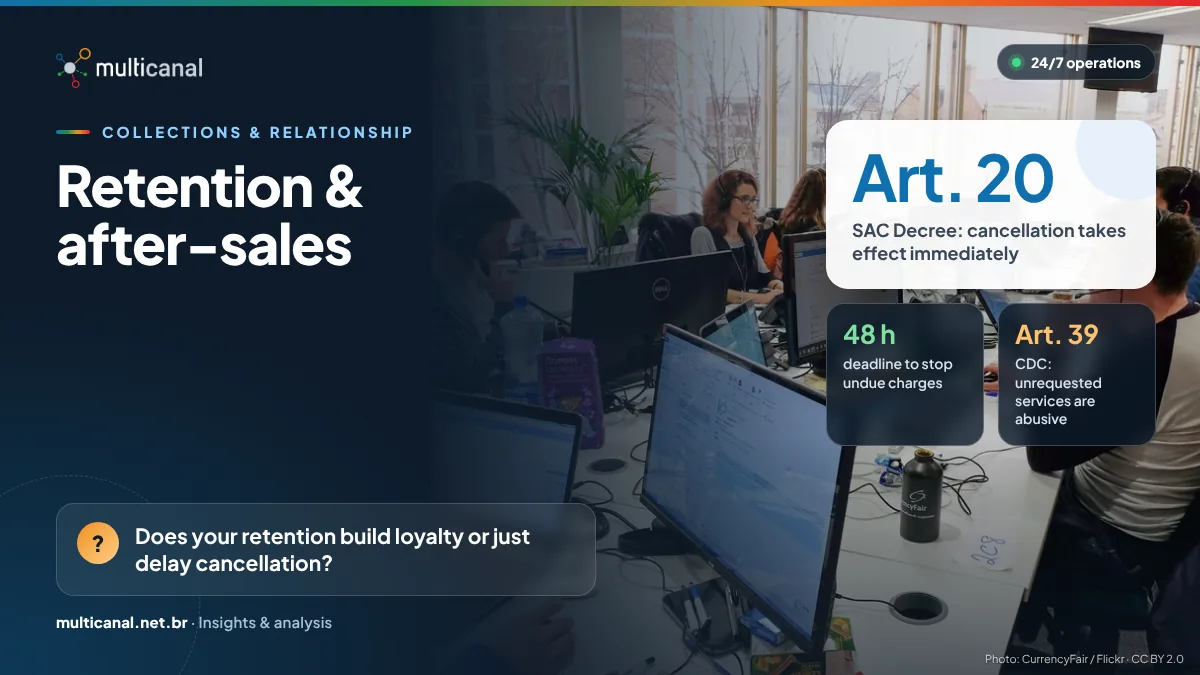
For suppliers covered by Brazil’s Decree 13,135/2026 (Decreto 13.135/2026), which has governed customer service (SAC) since November 2, 2026, the rule is explicit. A cancellation request must be received and processed by the SAC and by every channel used for signing up, in the same menu or with the same agent, and the consumer cannot be required to go to another menu, agent or channel. It takes effect immediately, regardless of whether the contract is paid up, unless technical processing is expressly justified (art. 20, § 1). Consumers must be informed of minimum-term penalties and other charges, receive proof electronically and may accept a scheduled cancellation. By phone and on electronic channels, the immediate cancellation option must be available at every level, including the first (arts. 13 and 16).
In other words, a retention offer is allowed, but it cannot condition or delay the request, and transferring the customer to another team as a condition for cancelling conflicts with the ban on requiring another agent. If the customer stands by the decision, the operation records it, confirms it and closes it.
After-sales and sales: value for the customer, not pressure
In after-sales, a welcome call, confirmation of installation or delivery and a satisfaction survey help prevent problems that would later turn into cancellation requests. Additional offers work when they start from the customer’s needs.
Brazil’s Consumer Protection Code (CDC) treats sending products or providing services without a prior request as an abusive practice (art. 39, III), and the SAC decree requires unrequested services or undue charges to be stopped within 48 hours (art. 21, § 3). Using personal data for offers requires a legal basis and transparency under the LGPD, Brazil’s data protection law, respecting those who asked not to receive offers.
Under the CDC, products sent and services provided without a prior request are treated as free samples: the consumer has no obligation to pay for them (art. 39, sole paragraph).
References and legislation
- Decreto 13.135/2026 · Brazil’s current SAC rules, including cancellation (art. 20) — access
- Decreto 11.034/2022 · previous SAC regulation, revoked — access
- Lei 8.078/1990 (CDC) · art. 39, abusive practices — access
- Lei 13.709/2018 (LGPD) · Brazil’s General Personal Data Protection Law — access
For us, the best retention metric is the customer who is still satisfied months later. Forced retention comes back as a complaint; well-handled retention comes back as loyalty.
— Multicanal Content Team · Multicanal Contact CenterHow Multicanal helps: we run retention, sales and after-sales with trained teams, CRM and operational reports, always preserving the right to cancel.
Discover our contact centerKeep reading
Ethical collections: what Brazil’s Consumer Protection Code forbids in arts. 42 and 71
Embarrassing, threatening or exposing debtors is not just bad practice: it can lead to double refunds and even criminal charges. See what the CDC forbids.
Brazil’s Over-indebtedness Law: what changes in collections and debt renegotiation
Law 14,181/2021 created responsible lending rules, protected the existential minimum and opened the way to debt restructuring. See the impact on collections.
Omnichannel collections cadence: from preventive reminders to negotiation
How to build a collections cadence that combines SMS, email, WhatsApp and phone at the right time, with the right message and within Brazilian rules and…