
Brazil’s Over-indebtedness Law: what changes in collections and debt renegotiation
Law 14,181/2021 created responsible lending rules, protected the existential minimum and opened the way to debt restructuring. See the impact on collections.
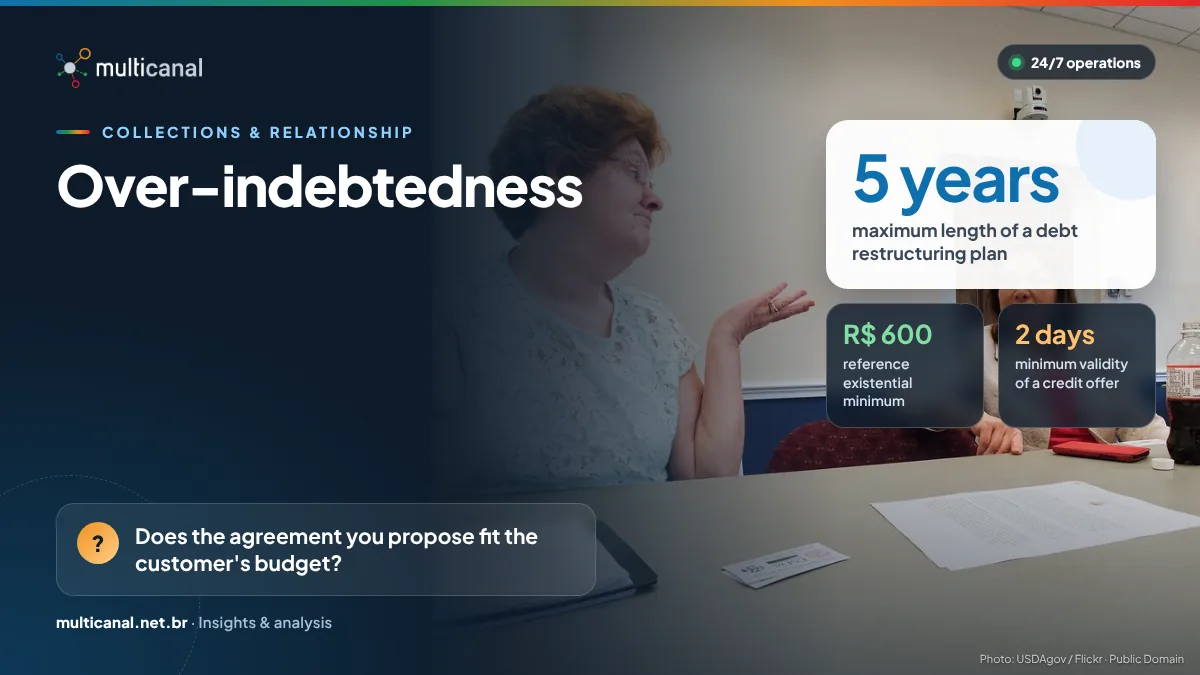
In July 2021, Law 14,181 (Lei 14.181/2021) added a chapter on preventing and treating over-indebtedness to Brazil’s Consumer Protection Code (CDC). The law changed how credit is offered, created a debt restructuring procedure and put the existential minimum at the center of negotiation. For those who collect and renegotiate, ignoring these rules means closing agreements that will not hold and may be reviewed.
What over-indebtedness means under the law
The CDC defines over-indebtedness as the manifest inability of a consumer who is a natural person, acting in good faith, to pay all of their consumer debts, due and falling due, without compromising their existential minimum (art. 54-A, § 1). It covers credit operations, installment purchases and continuous services; it excludes debts incurred through fraud or bad faith and those for high-value luxury goods and services.
The existential minimum is set by regulation: Decree 11,150/2022, as amended by Decree 11,567/2023, set the reference amount at R$ 600 per month. In April 2026, Brazil’s Supreme Federal Court (STF) ruled that the National Monetary Council (CMN) must assess these parameters every year and held, by majority, that payroll-deductible loan installments cannot compromise the existential minimum.
Prohibited practices and duties when offering credit
Renegotiation often involves a new credit offer or installment plan, and that is where the prohibitions of art. 54-C apply. Among them:
- hiding or obscuring the burdens and risks of the contract;
- harassing or pressuring consumers to sign up, especially if elderly, illiterate, ill or in a situation of heightened vulnerability;
- making service or the start of talks conditional on dropping lawsuits, paying attorney fees or making court deposits;
- suggesting that the operation does not require a credit bureau check or an assessment of the consumer’s financial situation.
When offering credit, companies must disclose the total effective cost, monthly interest rate, late-payment charges, installment amounts and the offer’s validity period, of at least two days (art. 54-B).
Restructuring: what the operation needs to know
At the request of an over-indebted consumer, a judge may open a restructuring process, with a conciliation hearing involving all creditors. The consumer presents a payment plan lasting up to five years, preserving the existential minimum (art. 104-A). Bodies of the National Consumer Protection System, such as the state Procons, may also run the conciliation phase (art. 104-C).
For collections, this means offers compatible with real payment capacity, complete written information, records of every negotiation and teams trained to recognize signs of over-indebtedness and guide customers on the options available.
If a creditor fails to attend the conciliation hearing without justification, the law provides for suspension of the debt’s enforceability, interruption of late-payment charges and, when the amount owed is certain and known to the consumer, compulsory subjection to the plan, with payment only after the creditors who attended (art. 104-A, § 2).
References and legislation
- Lei 14.181/2021 · Brazil’s Over-indebtedness Law — access
- Lei 8.078/1990 (CDC) · arts. 54-A to 54-G and 104-A to 104-C — access
- Decreto 11.567/2023 · existential minimum of R$ 600 — access
- STF, ADPFs 1005, 1006 and 1097 · annual review of the existential minimum (April 2026) — access
An agreement the customer cannot pay is not credit recovery; it just postpones the problem. We guide teams to ask before proposing and to record the payment capacity the customer reports: that is what makes an agreement hold.
— Multicanal Content Team · Multicanal Contact CenterHow Multicanal helps: when contracted, our collections and negotiation operation works with CDC-compliant scripts, records of every negotiation and teams trained in responsible lending.
Discover our collectionsKeep reading
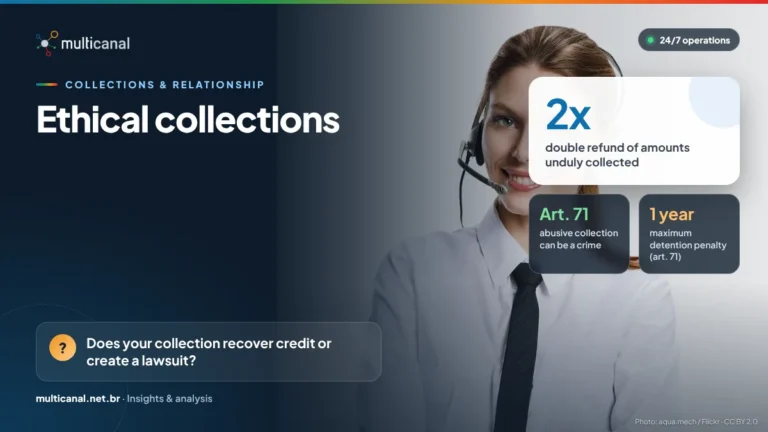
Ethical collections: what Brazil’s Consumer Protection Code forbids in arts. 42 and 71
Embarrassing, threatening or exposing debtors is not just bad practice: it can lead to double refunds and even criminal charges. See what the CDC forbids.
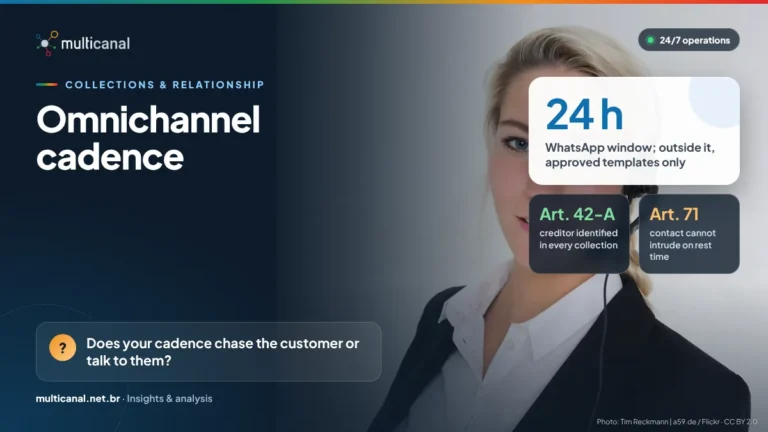
Omnichannel collections cadence: from preventive reminders to negotiation
How to build a collections cadence that combines SMS, email, WhatsApp and phone at the right time, with the right message and within Brazilian rules and…
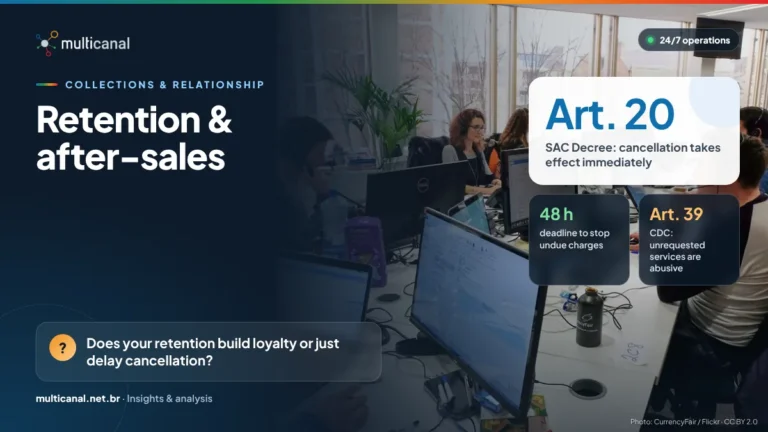
Retention and after-sales: the contact center as a revenue center
Retaining customers and selling after the sale takes balance: relevant offers, without making cancellation harder. See how to structure the operation within the rules.