
Contact center platform security: what to demand from licensed software and APIs
Omnichannel platforms, CRM, WhatsApp and call recording talk through APIs — and every integration is a door. See what to ask the vendor and what to check before connecting.
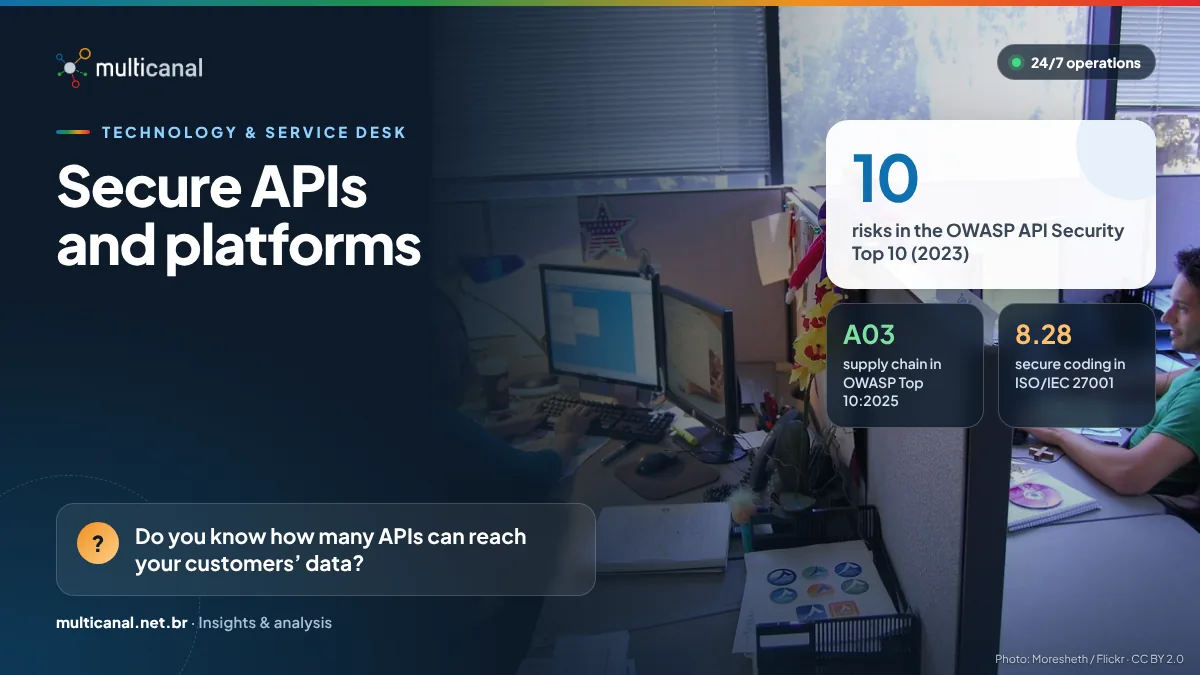
A modern customer service operation is an ecosystem: omnichannel platform, CRM, WhatsApp, IVR, call recording and reporting exchanging data through APIs. Each integration extends the reach of the service — and also the attack surface. For companies licensing software, the question is not whether there will be integrations, but what security evidence to demand before connecting them to customer data.
Where the risks are
The OWASP API Security Top 10 (2023 edition) ranks broken object level authorization first: the API returns data from a record without checking whether the requester is entitled to it. The list also includes broken authentication, unrestricted resource consumption, improper inventory management and unsafe consumption of third-party APIs. In the OWASP Top 10:2025, focused on web applications, software supply chain failures rank third — the risk also lies in the libraries and services the product depends on.
What to demand from licensed software
- Proven secure development: a secure life cycle policy, security testing and deadlines for fixing vulnerabilities. ISO/IEC 27001:2022 covers this in controls 8.25 to 8.29, and the NIST SSDF (SP 800-218) is a good reference for questions to the vendor.
- Role-based access: separate profiles for agent, supervisor and administrator, strong authentication, single sign-on where possible and audit trails.
- Data protection: encryption in transit and at rest, on-screen data masking, segregation between clients and configurable retention for recordings and attachments.
- Change management: release notes, maintenance windows and the ability to roll back updates.
- Contract and privacy law: controller and processor roles defined (LGPD, art. 39), known sub-processors, hosting location, incident notice deadlines compatible with ANPD Resolution No. 15/2024 and proven deletion of data at the end of the contract.
What to check in every API and integration
- Inventory: an up-to-date list of APIs, versions, environments and owners. A forgotten API is an unpatched API.
- Authorization on every call: object- and function-level checks, with minimal scopes for each integration.
- Protected secrets: tokens and keys in a vault, rotated regularly — never in code or spreadsheets.
- Authenticated webhooks: validate the signature and origin of incoming notifications.
- Limits and validation: cap request volumes and also validate data received from partners.
- Logs and alerts: preserved access logs and alerts for abnormal patterns, such as bulk extraction.
- Official channels: for WhatsApp, use Meta’s official platform rather than unauthorized tools.
Secure coding (control 8.28) is one of the 11 controls that debuted in ISO/IEC 27001:2022, alongside topics such as threat intelligence, data masking and data leakage prevention.
References and legislation
- OWASP Top 10:2025 · top risks in web applications — access
- OWASP API Security Top 10 — 2023 · top risks in APIs — access
- NIST SP 800-218 (SSDF) · secure software development practices — access
- ISO/IEC 27001:2022 · supplier controls (5.19 to 5.23) and secure development controls (8.25 to 8.29) — access
- Lei 13.709/2018 (LGPD) · Brazil’s data protection law, arts. 39 and 46 (in Portuguese) — access
When assessing platforms and integrations, we ask for evidence, not promises: test reports, an access matrix, a vulnerability policy and an exit plan. An integration only goes live once we know who is accountable for it.
— Multicanal Content Team · Multicanal Contact CenterHow Multicanal helps: the OMNI CHANNEL / App Multicanal platform is licensed and customized for each operation, integrated with WhatsApp Business through Meta’s official flow; Multicanal follows the standards of ISO/IEC 27001.
Explore the OMNI platformKeep reading
Service desk with ITIL 4 and ISO/IEC 20000-1: how to design SLAs that are actually met
A good SLA is one users can feel. Learn how to combine ITIL 4 practices with ISO/IEC 20000-1 requirements to build realistic, measured and improving agreements.
Knowledge base with KCS: how to cut repeat tickets at the service desk
When the same question is solved from scratch every day, the problem is knowledge. See how KCS turns each interaction into a useful, reusable article.
Tier 1, 2 and 3 support: how to structure levels and escalation rules
Tickets bouncing between teams are a sign of poorly defined levels. See the role of each tier, how to escalate with clear criteria and how to…