
Vishing: how to prepare agents to resist social engineering over the phone
Fake customers, fake IT support, spoofed numbers and even cloned voices. See how vishing reaches the contact center and which process, training and technology defenses work.
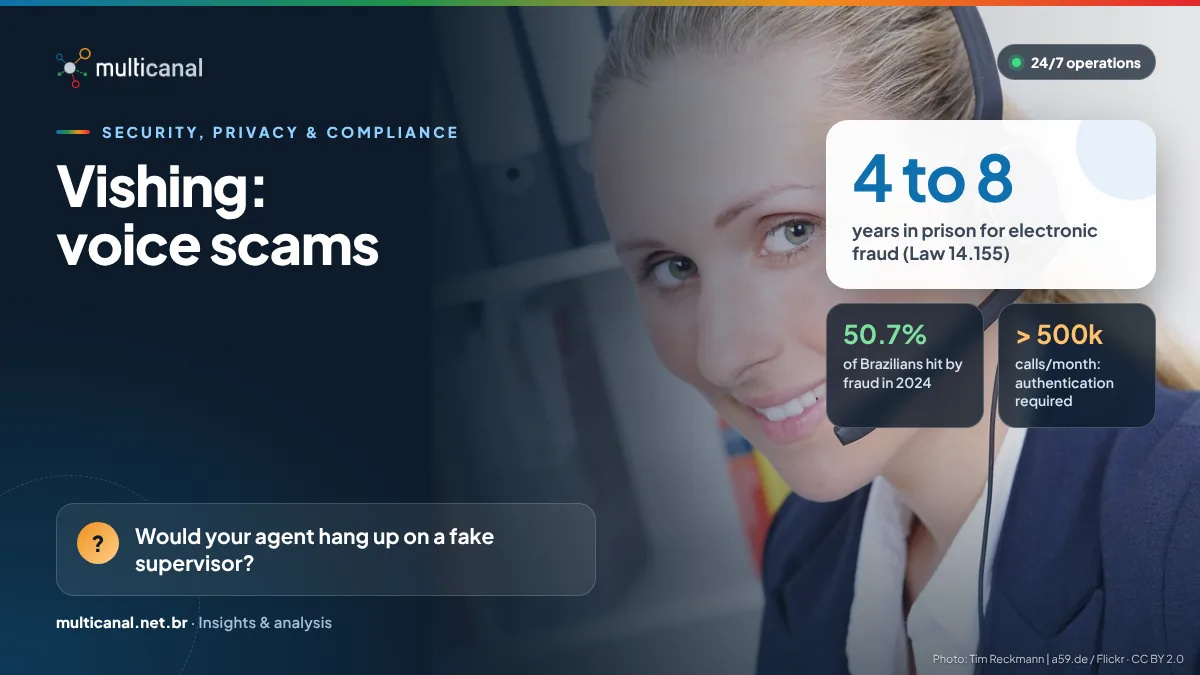
The phone rings and, on the other end, someone speaks confidently, uses the supervisor’s name, quotes customer data and asks for “just a quick confirmation”. Voice-based social engineering — vishing — exploits haste and the desire to help, two qualities of a good agent. In the contact center, the agent can be the direct target of the scam or the last barrier between a fraudster and a customer’s account.
How the scam reaches the contact center
- Fake customer: the fraudster uses leaked data to pass identity verification and asks to change a phone number, e-mail or address, for a duplicate card or for an unlock.
- Fake IT support or fake supervisor: calls the agent asking for a password, an authentication code or the installation of a remote access tool.
- Spoofed number: the call shows the company’s own number or that of a well-known partner.
- Synthetic voice: the diagnosis by Brazil’s ENCCLA on the “fake call center” scam already records the use of deepfakes to clone bank agents’ voices.
- Fake call center: the scammer poses as the company to the customer — and the agent needs to know how to guide suspicious callers.
The problem is widespread: according to a Serasa Experian survey cited by ENCCLA, 50.7% of Brazilians were victims of fraud in 2024.
The triggers agents need to recognize
Almost every vishing script combines the same elements: urgency (“your account will be blocked right now”), authority (“I’m from the board”, “I’m with the police”), fear, friendliness and, above all, the request to skip a step in the procedure. Training the team to recognize these signs — and to understand that ending the call is the right thing to do — is worth more than any list of prohibitions.
Defenses that work: process, training and technology
- Layered verification: do not rely only on registration data, which may have leaked; for sensitive changes, require an additional factor or confirmation through a channel already on file.
- Internal golden rule: nobody — not IT, not supervisors — asks for passwords or codes over the phone. Remote access only with a logged ticket.
- Call-back: when in doubt, end the call and call back on an official number.
- Immediate reporting: a simple channel to report attempts (ISO/IEC 27001:2022, control 6.8), with no embarrassment for whoever reports.
- Regular simulations: test calls with educational feedback, integrated into the awareness required by the standard (control 6.3).
- Call authentication: Anatel’s Origem Verificada (Verified Origin) service uses the STIR/SHAKEN protocols to authenticate the calling number and display the company’s name, logo and reason for the call; it became mandatory for those making more than 500,000 calls a month.
On the legal side, Brazil’s Law 14.155/2021 created the crime of electronic fraud in the Penal Code, punishable by 4 to 8 years of imprisonment when the victim or a third party is induced to provide information through phone contact, social networks or fraudulent e-mail.
In 2025, ENCCLA (Brazil’s National Strategy to Combat Corruption and Money Laundering) devoted an entire action to the “fake call center” scam, coordinated by Febraban and the Federal Police, with Anatel as a guest. The diagnosis describes variants such as the fake bank manager, the fake lawyer, the fake investigation and the fake IT technician.
References and legislation
- Lei 14.155/2021 · electronic fraud in art. 171 of the Brazilian Penal Code (in Portuguese) — access
- ENCCLA — Action 01/2025 · diagnosis of “fake call center” scams (in Portuguese) — access
- Anatel — Call authentication and identification · Origem Verificada and STIR/SHAKEN (in Portuguese) — access
- ISO/IEC 27001:2022 · awareness (6.3) and information security event reporting (6.8) — access
A well-trained agent is not afraid to say “I’ll call you back through the official channel”. Management’s job is to protect that attitude: whoever ends a suspicious call should be recognized, not penalized on average handling time.
— Multicanal Content Team · Multicanal Contact CenterHow Multicanal helps: in its training and development programs, Multicanal can include information security tracks and social engineering simulations tailored to each operation; the company follows the standards of ISO/IEC 27001.
Explore our trainingKeep reading
ISO/IEC 27001:2022 in the contact center: protecting data in every interaction
Every call or chat exposes personal data. See what changed in ISO/IEC 27001:2022 and which controls make a difference at the agent workstation, in access rights…
ISO/IEC 27701 and LGPD: turning privacy into a management system
Compliance with Brazil’s LGPD is not a project with an end date. See how ISO/IEC 27701:2025 organizes privacy into an auditable management system and how it…
ISO 37001 and ISO 37301 in public contracts: what Brazil’s Law 14.133 requires
Brazil’s Law 14.133/2021 made integrity programs mandatory in very large contracts and relevant in tie-breaks and sanctions. See how ISO 37001 and 37301 help structure them.