
Human-centred service in the age of automation: where people still make the difference
Bots handle the simple; people handle the complex and the sensitive. See where to automate, where to guarantee a human and what Brazil's new SAC decree now requires.
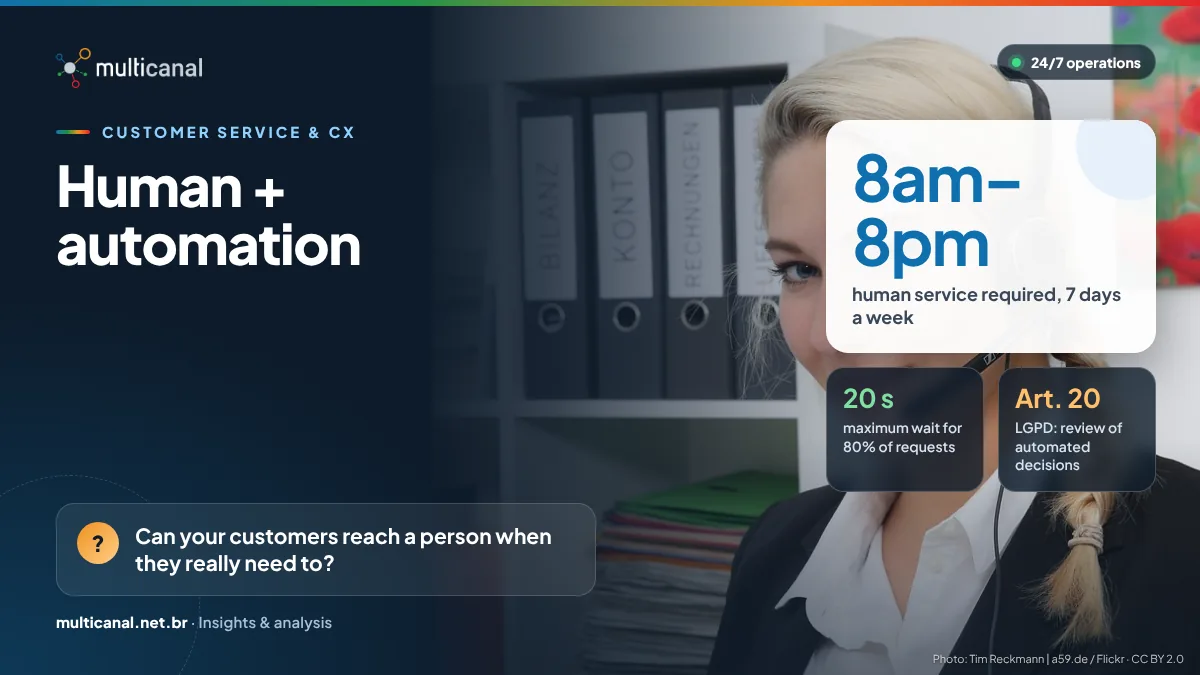
Automation shortens queues, works overnight and answers repetitive questions in seconds. But when the problem goes off script, involves money, health or strong emotions, customers want a person — and, since November 2026, the right to reach one has been written into Brazil’s customer service (SAC) decree, with set hours and waiting times.
The human option is no longer optional
Decree 13.135/2026 allows automated procedures, including artificial intelligence, for triage, routing and resolution, as long as consumers have the option of real-time service by a human being (art. 3, § 3). That option must be available from 8 a.m. to 8 p.m., every day, at every level of phone service (arts. 14 and 15) and on electronic channels (arts. 12 and 13), without requiring prior data to be routed (art. 8, sole paragraph). Human service, when requested, is even listed among the quality guarantees of customer service (art. 4, VIII).
Where people make the difference
- Non-standard cases: exceptions, cascading errors, requests that cut across several teams.
- Sensitive moments: bereavement, illness, fraud, collections, cancellation — situations where tone and empathy weigh as much as the answer.
- Vulnerable customers: the decree guarantees priority treatment for older people (art. 11) and broad accessibility for people with disabilities (art. 10); automation needs an easy way out to a human.
- Emergencies: requests involving significant risk to the consumer require immediate service, at any time (art. 17).
- Negotiation and retention: understanding context and building alternatives is human work.
Where to automate safely
Status checks, duplicate bills, scheduling, registration updates and FAQs are good candidates. The rule is simple: automate what is predictable and low-risk, keep the way out to a human always visible and never use automation to make cancellation harder — the decree requires that option at every level (arts. 13 and 16). When automation makes decisions that affect customers, the LGPD (Brazil’s data protection law) guarantees the right to request a review of decisions based solely on automated processing (art. 20) and to receive clear information about the criteria used.
Human service also means supporting the agent
Human-centred service is not a script full of friendly phrases. NR-17, Brazil’s ergonomics standard, forbids requiring strict adherence to scripts (Annex II, item 6.11) and guarantees a break right after calls involving threats, verbal abuse or aggression (item 6.4.5). Autonomy to solve problems, information on screen and respected breaks are what allow agents to truly listen.
One of the first chatbots, ELIZA, was created by Joseph Weizenbaum at MIT and described in 1966. Even though it ran on simple keyword rules, it led users to attribute understanding and empathy to the machine — a phenomenon that became known as the “ELIZA effect”.
References and legislation
- Decreto nº 13.135/2026 · customer service (SAC): AI allowed with a real-time human option — access
- Lei nº 13.709/2018 (LGPD) · Brazil’s data protection law; art. 20: review of automated decisions — access
- NR-17, Anexo II · teleservice work: scripts, breaks and work organisation — access
- ELIZA (Communications of the ACM, 1966) · Joseph Weizenbaum’s paper on the program — access
We believe in automation that opens the way to a person, not automation that hides them. A good sign of a well-designed bot is a customer who reaches the agent already identified, with context recorded and nothing to repeat.
— Multicanal Content Team · Multicanal Contact CenterHow Multicanal helps: we combine inbound and outbound service with digital channels and trained teams, so automation handles the simple and people take care of what requires listening and decisions.
Explore our contact centerKeep reading
Brazil’s new SAC Decree (13.135/2026): what changed since 11.034 and how to adapt
In force since November 2, 2026, Decree 13.135 revoked Decree 11.034/2022, requiring human service from 8 a.m. to 8 p.m., a 20-second wait for 80% of…
FCR: why first contact resolution moves satisfaction and cost at the same time
Every repeat contact is service paid twice and a less satisfied customer. Learn how to measure FCR without distortion, what Brazil's new SAC decree requires and…
NPS, CSAT and CES: what each metric measures, when to use it and how to act on results
Three acronyms, three different questions. Learn the origin and calculation of NPS, CSAT and CES, the right moment for each survey and how to turn scores…