
Brazil’s new SAC Decree (13.135/2026): what changed since 11.034 and how to adapt
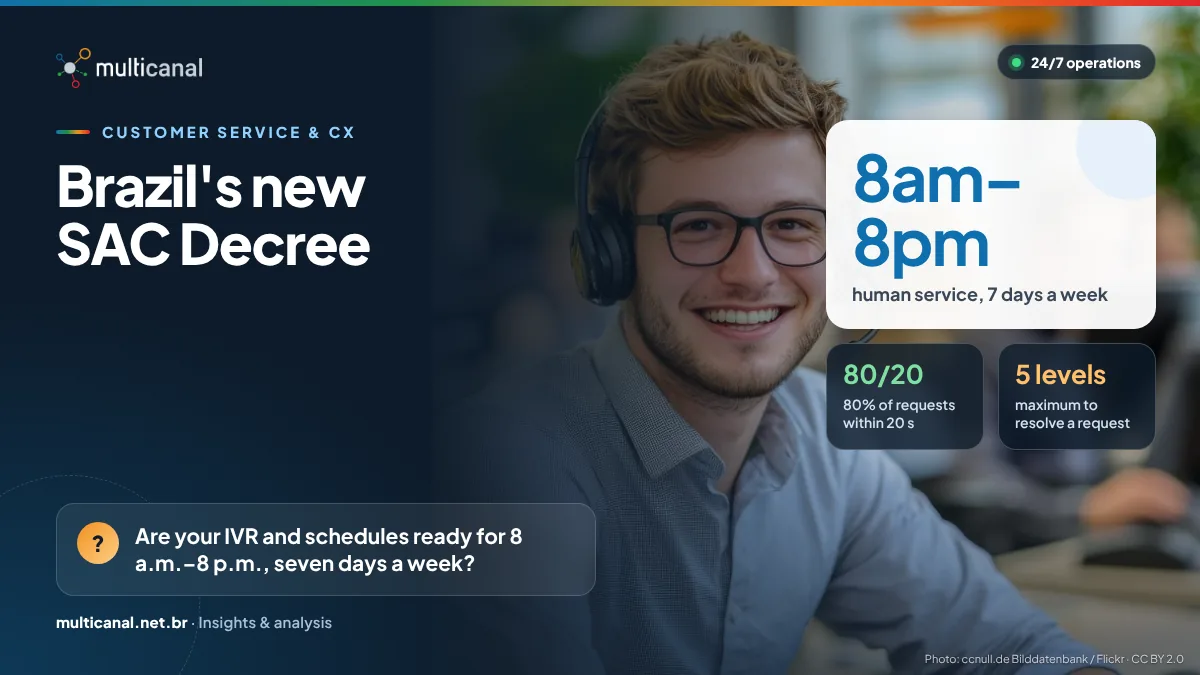
In force since November 2, 2026, Decree 13.135 revoked Decree 11.034/2022, requiring human service from 8 a.m. to 8 p.m., a 20-second wait for 80% of requests and a five-level limit.
Anyone still running customer service (SAC) under Decree 11.034/2022 is following a revoked rule. Since November 2, 2026, Brazil’s Decree 13.135/2026 has made human service a daily obligation from 8 a.m. to 8 p.m., set a maximum waiting time and limited the steps needed to reach a solution. The change affects staffing, IVR, chat and KPIs — and took effect just 20 days after publication.
From 11.034/2022 to 13.135/2026
Often called the “SAC Law”, the subject is actually governed by a decree that regulates Brazil’s Consumer Protection Code (CDC). The 2022 rule already guaranteed free access, at least one 24/7 channel, complaint and cancellation options in the first menu and a reply within seven calendar days. On the phone, however, it required human service for at least eight hours a day and left waiting times to sector regulators. Decree 13.135 of October 9, 2026, published in the Official Gazette on October 13, revoked that rule (art. 24) and took effect 20 days after publication (art. 25).
Key changes
- Human service from 8 a.m. to 8 p.m., seven days a week: on the phone (art. 14, § 1) and in real time on electronic channels (art. 12, § 1); at least one electronic channel remains available 24 hours.
- Maximum wait: up to 20 seconds for at least 80% of answered requests and up to 300 seconds for the rest, when the consumer chooses to talk to a person (art. 15, I), unless a regulator sets a specific rule.
- Agent and cancellation at every level: including the first, with no more than five levels to resolve a request and no pushing customers to another channel (arts. 13 and 16).
- Call dropped? Call back within 300 seconds, using what the customer already said and providing the protocol number (art. 14, § 3).
- Advertising banned at any stage, including while waiting; the consent exception no longer exists (art. 6, I).
- Undue charges or unrequested services: immediate action and completion within 48 hours (art. 21, § 3).
- History and recordings: history sent within five business days and kept for six months; recordings and voice or text messages kept for 90 days (arts. 18 and 19).
- Artificial intelligence allowed for triage and resolution, as long as consumers can choose real-time human service (art. 3, § 3).
The scope also grew: besides services regulated by the federal Executive, it covers digital financial services supervised by the Central Bank; marketplaces, ride-hailing and delivery platforms must submit their customer service models to Senacon (the National Consumer Secretariat), which supervises and imposes sanctions (arts. 1, 2 and 23).
How to adapt your operation
- Sizing and scheduling: recalculate staff to cover 8 a.m.–8 p.m. every day, including weekends and holidays, in line with NR-17 (Brazil’s ergonomics standard) and collective agreements.
- IVR and chat: no more than five levels, with “talk to an agent” and “cancel” visible from the first one, plus an estimated waiting time.
- KPIs: measure the 20-second service level per interval and track the tail above 300 seconds, not just the average.
- Systems: active-request history on the agent’s screen, a callback routine and retention of recordings and messages aligned with the LGPD (Brazil’s data protection law).
- Regulated sectors: check whether your sector’s agency has its own waiting-time rule, which prevails over the general one.
The new decree also requires covered companies to keep a telephone channel dedicated to serving Procons (consumer protection agencies) and other bodies of Brazil’s National Consumer Protection System (art. 22).
References and legislation
- Decreto nº 13.135/2026 · regulates customer service (SAC); in force since Nov 2, 2026 — access
- Decreto nº 11.034/2022 · previous regulation, revoked by art. 24 of the new decree — access
- Lei nº 8.078/1990 (CDC) · Brazil’s Consumer Protection Code — access
- NR-17, Anexo II · teleservice/telemarketing work: working hours and breaks — access
In our view, the bottleneck is rarely the IVR: it is scheduling. Covering 8 a.m.–8 p.m. every day with 80% of calls answered within 20 seconds requires interval-based sizing, break management and daily KPI tracking.
— Multicanal Content Team · Multicanal Contact CenterHow Multicanal helps: we run customer service (SAC/CAC) 24/7, with workforce management (WFM), call recording and operational reports that help meet the new hours and waiting-time requirements.
Explore our customer service solutionKeep reading
FCR: why first contact resolution moves satisfaction and cost at the same time
Every repeat contact is service paid twice and a less satisfied customer. Learn how to measure FCR without distortion, what Brazil's new SAC decree requires and…
NPS, CSAT and CES: what each metric measures, when to use it and how to act on results
Three acronyms, three different questions. Learn the origin and calculation of NPS, CSAT and CES, the right moment for each survey and how to turn scores…
Human-centred service in the age of automation: where people still make the difference
Bots handle the simple; people handle the complex and the sensitive. See where to automate, where to guarantee a human and what Brazil's new SAC decree…