
NPS, CSAT and CES: what each metric measures, when to use it and how to act on results
Three acronyms, three different questions. Learn the origin and calculation of NPS, CSAT and CES, the right moment for each survey and how to turn scores into action.
Many companies collect satisfaction scores every month and change little because of them. Part of the problem is using the wrong metric for the right question: NPS, CSAT and CES measure different things, at different moments, and only create value when the customer’s answer becomes a decision.
Three questions, three purposes
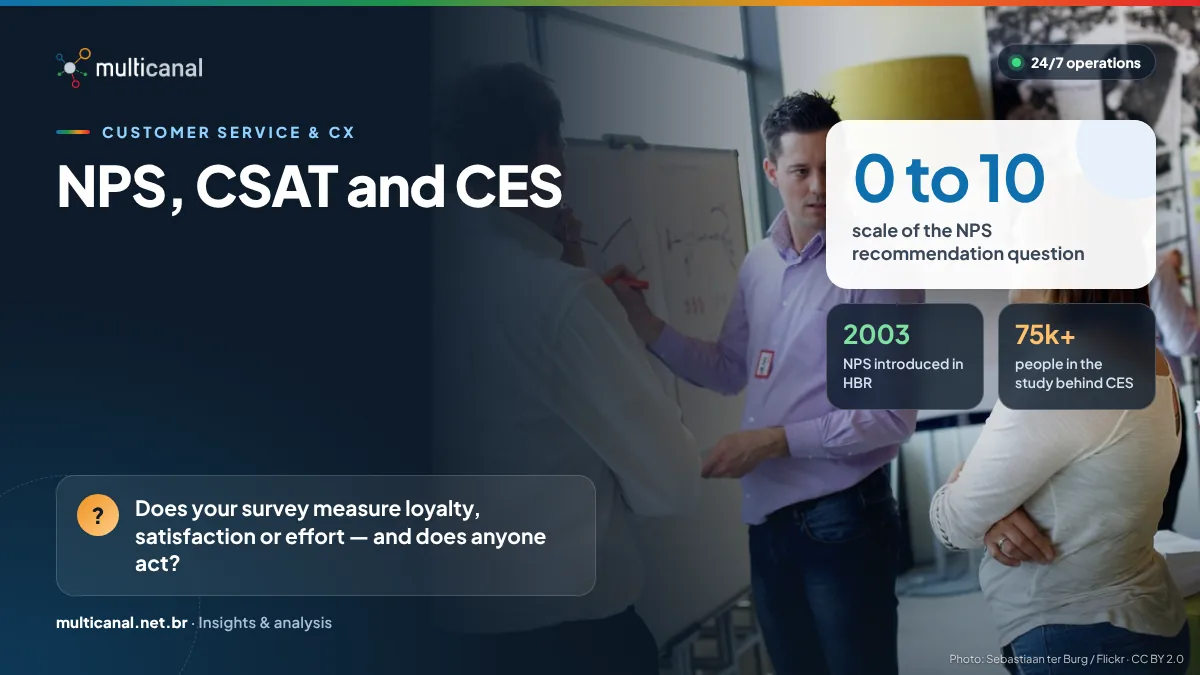
- NPS (Net Promoter Score): asks how likely the customer is to recommend the company to a friend or colleague, from 0 to 10. Scores of 9 and 10 are promoters; 0 to 6, detractors; 7 and 8, passives. NPS is the percentage of promoters minus the percentage of detractors, ranging from −100 to +100. Frederick Reichheld introduced it in Harvard Business Review in December 2003, and it measures relationship and loyalty.
- CSAT (Customer Satisfaction): asks how satisfied the customer was with a specific interaction or delivery, usually on a short scale such as 1 to 5; the result is often the percentage of top scores. It measures the experience of one moment.
- CES (Customer Effort Score): asks how much effort the customer had to make to resolve the request — or whether they agree the company made it easy. It was introduced in the article “Stop Trying to Delight Your Customers”, published in HBR in 2010, which argued for reducing customer effort instead of trying to delight at any cost.
When to measure each one
CSAT and CES work best right after the contact, while the experience is fresh: at the end of the call via IVR, when the chat closes or by message a few minutes later. CES is especially useful for assessing processes — duplicate bills, exchanges, cancellations. NPS is about the relationship: it makes more sense in periodic cycles or at journey milestones, such as after purchase. Sending NPS after every contact mixes the brand assessment with the last interaction and tires customers.
From score to action: closing the loop
ISO 10004:2018, which provides guidelines for monitoring and measuring customer satisfaction, treats measurement as a process: plan, collect, analyse, communicate results and follow up on the actions taken. In customer service, this means:
- Always including an open question (“what drove your score?”) and categorising comments by reason.
- Crossing scores with operational data — contact reason, channel, waiting time, repeat contact — to find causes, not culprits.
- Getting back to detractors and high-effort customers quickly, the so-called closed loop.
- Tracking trends and sufficient samples, not one day’s or one agent’s isolated score.
Satisfaction is also a regulatory parameter: Brazil’s Decree 13.135/2026 requires marketplace, ride-hailing and delivery platforms to report consumer satisfaction levels to Senacon, the National Consumer Secretariat (art. 2, IV).
Net Promoter®, NPS® and Net Promoter System® are registered trademarks of Bain & Company, Inc., NICE Systems, Inc. and Fred Reichheld.
The study behind CES, carried out by the Corporate Executive Board, looked at more than 75,000 people who spoke with contact-centre agents or used self-service channels. Its conclusion: over-the-top efforts to delight make little difference; what customers want is a simple, quick solution.
References and legislation
- The One Number You Need to Grow (HBR, 2003) · Frederick Reichheld’s article that introduced NPS — access
- Stop Trying to Delight Your Customers (HBR, 2010) · article by Dixon, Freeman and Toman that introduced CES — access
- Measuring Your Net Promoter Score (Bain & Company) · official NPS question and calculation — access
- ISO 10004:2018 · guidelines for monitoring and measuring customer satisfaction — access
- Decreto nº 13.135/2026 · Brazil’s customer service (SAC) regulation; satisfaction reporting (art. 2) — access
Our advice is to choose a few questions and act on them with discipline. A poor CES in a specific process usually shows where to start; a falling NPS calls for looking at the whole journey, not just customer service.
— Multicanal Content Team · Multicanal Contact CenterHow Multicanal helps: our customer service (SAC/CAC) operation combines call recording and operational reports to link each customer score to what actually happened in the interaction and guide improvements.
Explore our customer serviceKeep reading

Brazil’s new SAC Decree (13.135/2026): what changed since 11.034 and how to adapt
In force since November 2, 2026, Decree 13.135 revoked Decree 11.034/2022, requiring human service from 8 a.m. to 8 p.m., a 20-second wait for 80% of…
FCR: why first contact resolution moves satisfaction and cost at the same time
Every repeat contact is service paid twice and a less satisfied customer. Learn how to measure FCR without distortion, what Brazil's new SAC decree requires and…
Human-centred service in the age of automation: where people still make the difference
Bots handle the simple; people handle the complex and the sensitive. See where to automate, where to guarantee a human and what Brazil's new SAC decree…