
FCR: why first contact resolution moves satisfaction and cost at the same time
Every repeat contact is service paid twice and a less satisfied customer. Learn how to measure FCR without distortion, what Brazil's new SAC decree requires and where to act.
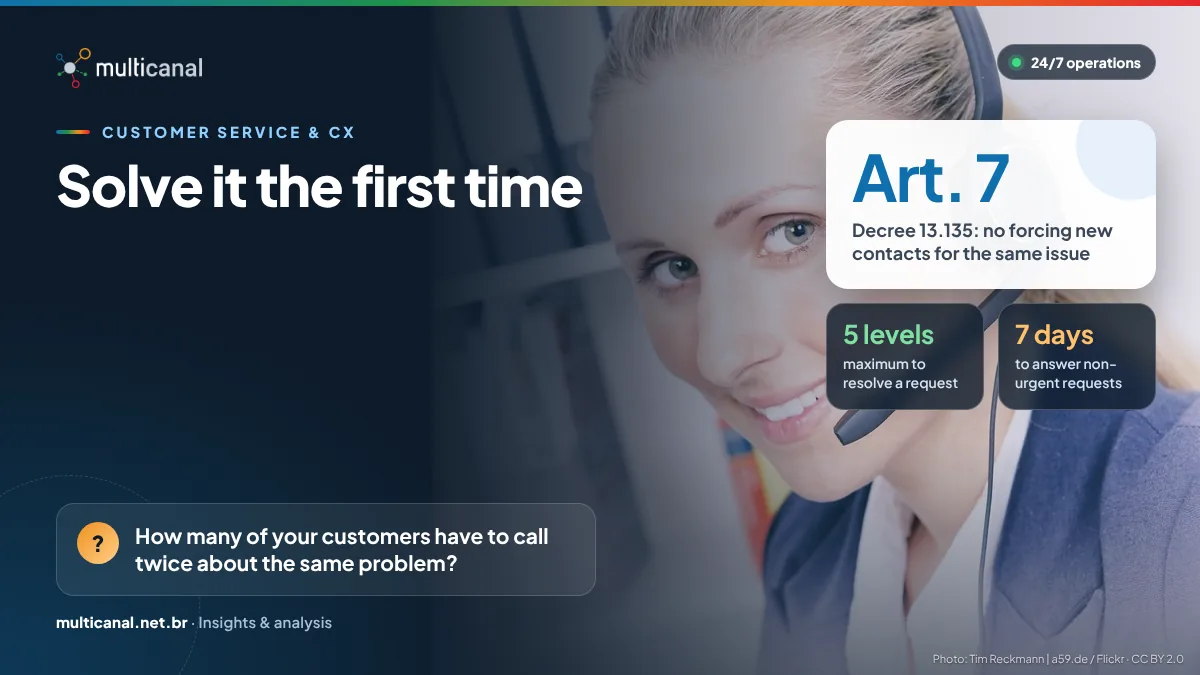
When customers have to call again to solve the same problem, the company pays twice for the service and ends up with a more irritated customer. FCR (first contact resolution) measures exactly that — and, with Brazil’s new customer service (SAC) decree, it has moved from good practice to something close to a requirement.
What FCR is and why it matters
FCR is the percentage of requests resolved on the first contact, with no need for the customer to come back and no transfer to another team. It is a rare KPI because it speaks to both sides of the business: every avoided contact frees up capacity, and every problem solved the first time reduces customer effort, which tends to show up in satisfaction and loyalty. That is why looking only at AHT (average handling time) is misleading: a short call that generates a repeat contact costs more than a slightly longer one that closes the matter.
How to measure it without fooling yourself
There is no single market formula, and that is where the risk lies. The most common methods combine sources:
- Repeat contact in the system: the same customer returns for the same reason within a defined window (for example, seven days). It is objective, but depends on customer identification and reliable contact-reason tagging.
- Post-contact survey: the direct question “was your request resolved?” captures the customer’s view, but depends on response rates.
- Agent self-report: easy to collect and easy to inflate; use it as support, never as the only source.
Three precautions prevent pretty but false numbers: measure resolution across channels (a chat followed by a call is a repeat contact), separate requests that depend on third parties and never reward closing a ticket without solving it.
What Brazil’s new SAC decree has to do with it
Decree 13.135/2026, in force since November 2, lists resolution among the guarantees of customer service (art. 4), forbids asking consumers to repeat a request already registered, except for a justified technical reason (art. 6, II), and bans requiring them to restart the service or make new contacts for the same request (art. 7). It also requires the system to show agents the customer’s active request history (art. 18, § 1) and limits to five the number of service levels before a solution (arts. 13 and 16). In other words, avoidable repeat contacts have become a regulatory risk.
Levers to raise FCR
- An up-to-date knowledge base that is easy to consult during the contact.
- Clear authority levels: what agents can solve without transferring.
- A single customer view, with the history of all channels on the same screen.
- Analysis of repeat-contact reasons to fix the cause — process, system or communication — not just the service.
- Quality monitoring and coaching focused on diagnosis and resolution, not scripts.
On consumidor.gov.br — a free public service monitored by Senacon (Brazil’s National Consumer Secretariat) and launched in 2014 — companies have up to 10 days to reply, and the consumer decides whether the complaint was “resolved” or “not resolved”. It is resolution measured from the customer’s point of view, the same principle that should guide FCR.
References and legislation
- Decreto nº 13.135/2026 · Brazil’s customer service (SAC) rules: resolution, history and service levels — access
- Lei nº 8.078/1990 (CDC) · Brazil’s Consumer Protection Code — access
- Consumidor.gov.br · how Brazil’s public consumer dispute-resolution service works — access
- ISO 18295-1:2017 · service requirements for customer contact centres — access
When FCR does not improve, the problem is rarely just the agent. In general, the biggest gains come from fixing the cause of repeat contacts: a confusing bill, a system that hides the history, an authority level that is too narrow.
— Multicanal Content Team · Multicanal Contact CenterHow Multicanal helps: we structure customer service (SAC/CAC) operations with CRM, call recording and operational reports that help identify repeat contacts and solve more on the first interaction.
Explore our customer serviceKeep reading

Brazil’s new SAC Decree (13.135/2026): what changed since 11.034 and how to adapt
In force since November 2, 2026, Decree 13.135 revoked Decree 11.034/2022, requiring human service from 8 a.m. to 8 p.m., a 20-second wait for 80% of…
NPS, CSAT and CES: what each metric measures, when to use it and how to act on results
Three acronyms, three different questions. Learn the origin and calculation of NPS, CSAT and CES, the right moment for each survey and how to turn scores…
Human-centred service in the age of automation: where people still make the difference
Bots handle the simple; people handle the complex and the sensitive. See where to automate, where to guarantee a human and what Brazil's new SAC decree…