
Sanitation contact centers: putting users at the heart of Brazil’s new legal framework
With targets of 99% water and 90% sewage coverage by 2033, Brazil's Sanitation Framework means more works, connections and contacts. What the law and ANA expect from service.
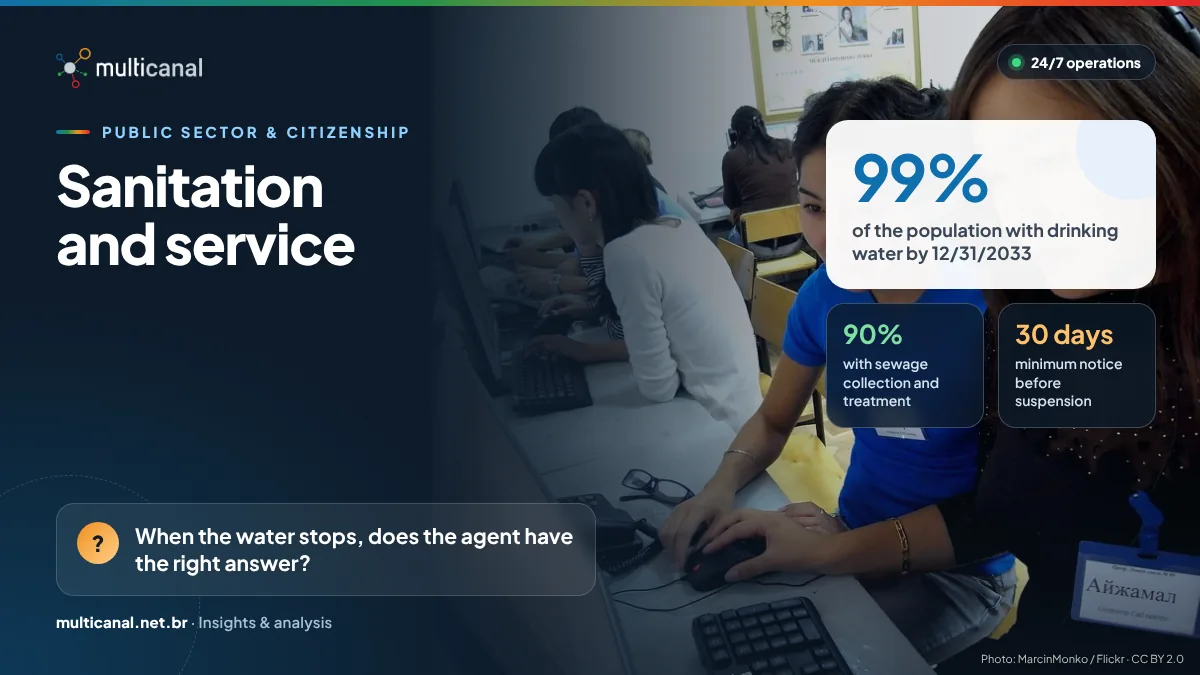
Lei 14.026/2020, Brazil’s Sanitation Legal Framework, updated Lei 11.445/2007 and set universal coverage targets: 99% of the population with drinking water and 90% with sewage collection and treatment by December 31, 2033 (art. 11-B). More networks mean more connections, works, scheduled interruptions, bills and questions — and each of them reaches the contact center first.
What the law guarantees users
Lei 11.445/2007 ensures broad access to information about services, prior knowledge of rights, duties and penalties, access to a service and customer care manual approved by the regulatory agency, and periodic quality reports (art. 27). Regulatory agencies, following guidelines from ANA (the National Water and Sanitation Agency), must issue rules on customer service standards and participation and information mechanisms (art. 23, X).
Two points directly affect the contact center’s scripts: scheduled interruptions must be announced in advance to the regulator and users, and suspension for non-payment requires at least 30 days’ notice, with special criteria for health facilities, schools and low-income users on the social tariff (art. 40). Lei 13.460/2017 also forbids suspending a public service for non-payment starting on a Friday, weekend, holiday or the day before a holiday (art. 6, sole paragraph).
ANA’s Reference Standard 11 and customer service
Reference Standard No. 11/2024, approved by ANA Resolution No. 230/2024, covers the general conditions for water and sewage services. According to ANA’s guidance manual, providers must offer service by phone, electronic means and other channels defined by the regulator, 24 hours a day, 7 days a week, including an in-person office; record and number each request, giving the user a ticket number; and, as a recommendation, run an ombudsman office for unresolved cases. The manual also calls for a monthly report to the regulator with complaints classified by reason and the percentage not resolved.
How to organize the contact center
- Standardized contact reasons (no water, leaks, quality, billing, new connection, reconnection, sewage), aligned with the regulator’s report.
- Integration with field work orders, to give deadlines and status without transferring the user.
- Proactive communication of interruptions by SMS, WhatsApp and website, reducing call peaks.
- Priority for emergencies, such as major leaks and sewage backflow.
- A collections flow that respects the 30-day notice and informs about the social tariff.
Multicanal knows this routine first-hand: it runs an operation in Uberlândia, Minas Gerais, for DMAE (the Municipal Water and Sewage Department) and counts EMBASA among its clients.
Lei 15.012/2024 added to sanitation users’ rights access to periodic reports on the level of public water supply reservoirs and other water security data (Lei 11.445/2007, art. 27, V).
References and legislation
- Lei 14.026/2020 · Brazil’s Sanitation Legal Framework (in Portuguese) — access
- Lei 11.445/2007 · national sanitation guidelines (updated text; arts. 11-B, 23, 27, 40, in Portuguese) — access
- ANA Resolution No. 230/2024 · approves Reference Standard No. 11 (general conditions for water and sewage, in Portuguese) — access
- ANA guidance manual for RS 11 · customer service standards (in Portuguese) — access
- Lei 13.460/2017 · rights of public service users (art. 6, in Portuguese) — access
In sanitation, the best call is the one that never had to happen: warning in advance about works and interruptions reduces queues and complaints. When the contact comes, the agent must see the work order to answer with a deadline, not a promise.
— Multicanal Content Team · Multicanal Contact CenterHow Multicanal helps: we run 24-hour inbound service integrated with digital channels, with ticket numbers, standardized contact reasons and operational reports that support accountability to the regulator.
Discover our contact centerKeep reading
Lei 13.460/2017: what Brazil’s public service user code requires from customer service
Service Charter, ombudsman, 30-day deadline and satisfaction surveys: see what Brazil's Lei 13.460/2017 requires and how to bring these rules into a citizen service center.
Lei 14.133/2021: how to procure contact center and IT services with SLAs and IMR that work
Brazil's new Procurement Law favors results-based contracts. See how to design service levels and an IMR for contact centers and service desks that measure what matters.
Public ombudsman offices and Fala.BR: how to integrate citizens’ feedback channels
Citizens complain by phone, WhatsApp, email or in person, but the ombudsman needs a single record. See how to connect the service center to Fala.BR and…