
Lei 13.460/2017: what Brazil’s public service user code requires from customer service
Service Charter, ombudsman, 30-day deadline and satisfaction surveys: see what Brazil's Lei 13.460/2017 requires and how to bring these rules into a citizen service center.
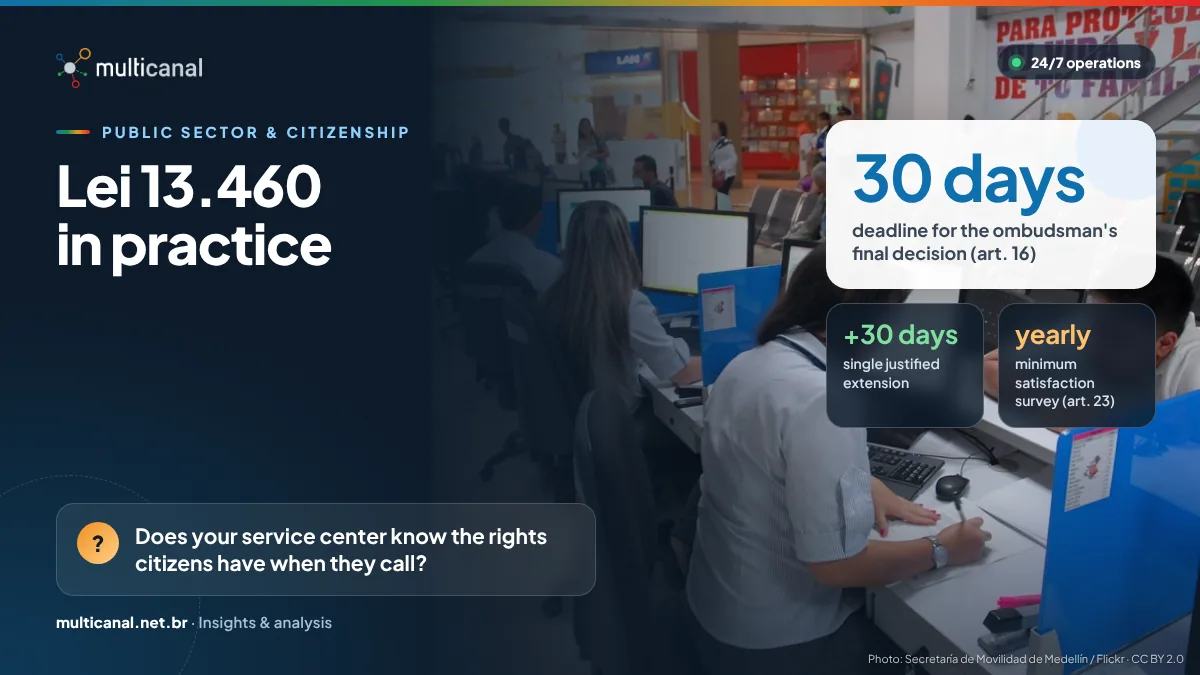
Since 2017, users of public services in Brazil have had their own code of rights. Lei 13.460/2017 applies to the direct and indirect administration of the Federal Government, States, the Federal District and Municipalities, and applies subsidiarily to public services provided by private companies (art. 1). It is in the service center — phone, WhatsApp, chat or front desk — that these rights become real or stay on paper.
Guidelines that change the way we serve
Article 5 lists what is expected from those who serve: civility, respect, accessibility and courtesy; presumption of the user’s good faith; first-come, first-served attention, with legal priorities; equal treatment; meeting deadlines; plain language, without acronyms, jargon or foreign terms; and a ban on demanding new proof of facts already proven. The law also guarantees prior notice before a service is cut off for non-payment and forbids the suspension from starting on a Friday, weekend, holiday or the day before a holiday (art. 5, XVI, and art. 6, sole paragraph, added by Lei 14.015/2020).
Service Charter and user submissions
Each body must publish a Service Charter (Carta de Serviços ao Usuário) with requirements, steps, maximum deadline, expected waiting time, communication mechanisms and procedures for receiving and answering submissions (art. 7). Submissions — complaints, reports, suggestions, compliments — can be made electronically, by mail or verbally, in which case they must be put in writing (art. 10, § 4), and they can never be refused (art. 11). Effective resolution involves receipt through the proper channel, proof of receipt, analysis, a final administrative decision and notice to the user (art. 12). The ombudsman office has 30 days to send the final decision, extendable once for the same period with justification (art. 16).
Ongoing evaluation and the role of the service center
Services must be evaluated for satisfaction, quality of service, compliance with deadlines, number of submissions and measures taken, with a satisfaction survey at least once a year and published results (art. 23). For the service center, this means:
- a single ticket number across all channels, aligned with the steps of art. 12;
- plain-language scripts consistent with the Service Charter;
- standardized contact reasons that feed the ombudsman’s annual management report (arts. 14 and 15);
- internal deadline control compatible with the law’s 30 days;
- post-contact surveys integrated into ongoing evaluation.
This is the design Multicanal applies at the Citizen Service Center of the General Ombudsman Office of the Municipality of Boa Vista, Roraima (Contract No. 970/2026, in force from 10/02/2026 to 10/01/2027).
Lei 13.460 came into force in stages: 360 days after publication for the Federal Government, States, the Federal District and municipalities with more than 500,000 inhabitants; 540 days for those with 100,000 to 500,000; and 720 days for those with fewer than 100,000 inhabitants (art. 25).
References and legislation
- Lei 13.460/2017 · participation, protection and defense of public service users’ rights (updated text, in Portuguese) — access
- Lei 14.129/2021 · Digital Government Law; made the CPF taxpayer number sufficient ID (art. 10-A of Lei 13.460, in Portuguese) — access
- Decree 9.492/2018 · regulates Lei 13.460 in the federal Executive and creates the Ombudsman System (in Portuguese) — access
In practice, Lei 13.460 works when the service center and the ombudsman share the same record and the same language. Citizens do not need to know which department solves the problem: they need a ticket number, a deadline and an answer.
— Multicanal Content Team · Multicanal Contact CenterHow Multicanal helps: we are registered in SICAF, Brazil’s federal supplier registry, and set up citizen service centers with a single ticket number, plain language and reports that support the ombudsman office.
Discover our customer serviceKeep reading
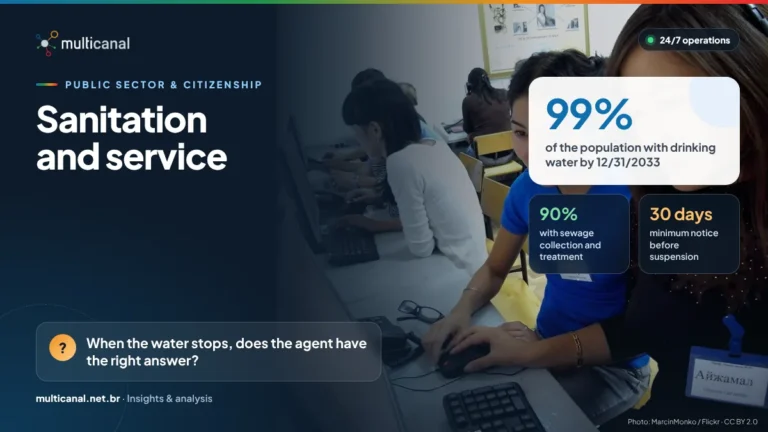
Sanitation contact centers: putting users at the heart of Brazil’s new legal framework
With targets of 99% water and 90% sewage coverage by 2033, Brazil's Sanitation Framework means more works, connections and contacts. What the law and ANA expect…
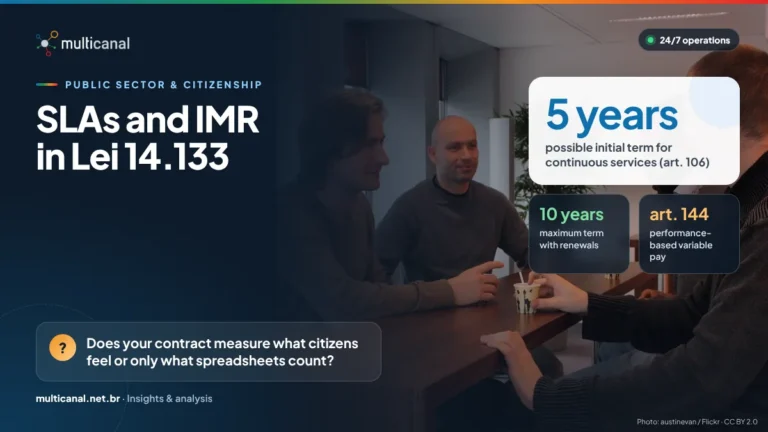
Lei 14.133/2021: how to procure contact center and IT services with SLAs and IMR that work
Brazil's new Procurement Law favors results-based contracts. See how to design service levels and an IMR for contact centers and service desks that measure what matters.
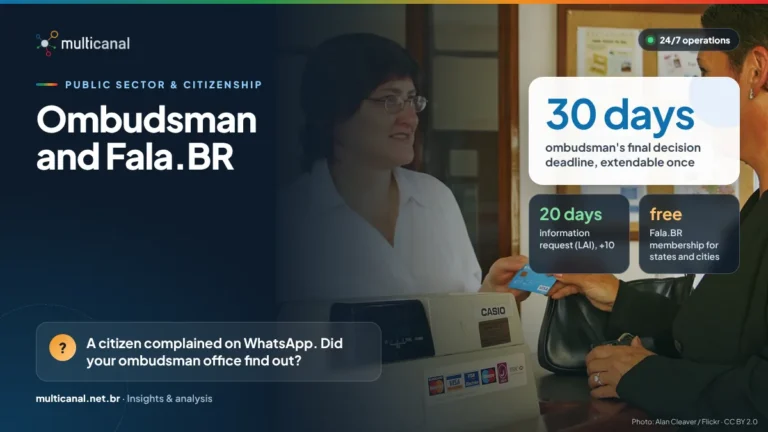
Public ombudsman offices and Fala.BR: how to integrate citizens’ feedback channels
Citizens complain by phone, WhatsApp, email or in person, but the ombudsman needs a single record. See how to connect the service center to Fala.BR and…