
Lei 14.133/2021: how to procure contact center and IT services with SLAs and IMR that work
Brazil's new Procurement Law favors results-based contracts. See how to design service levels and an IMR for contact centers and service desks that measure what matters.
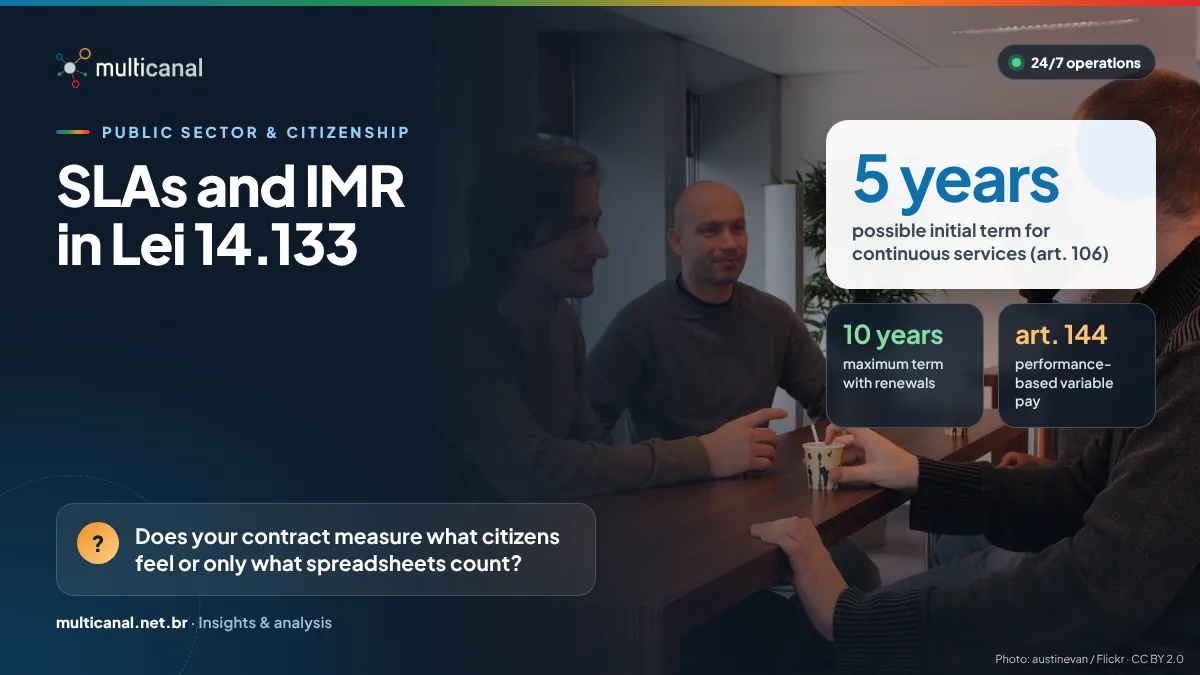
Contact center and service desk contracts tend to fail less because of price and more because of measurement: too many indicators, poorly defined or impossible to audit. Lei 14.133/2021, Brazil’s Public Procurement Law, brought tools for results-based contracting, but they only work if the terms of reference translate citizens’ needs into clear service levels and a workable Results Measurement Instrument (IMR).
What Lei 14.133 offers
- Complete terms of reference: execution model, contract management model and measurement and payment criteria are mandatory elements (art. 6, XXIII).
- Terms suited to continuous services: contracts of up to 5 years (art. 106), renewable successively up to a maximum of 10 years if conditions remain advantageous (art. 107).
- Variable pay: payment can be tied to performance, based on targets, quality standards and deadlines set in the tender and contract (art. 144).
- Active oversight: appointed contract inspectors record occurrences and order corrections (art. 117).
- Social obligations: declaration and maintenance of job quotas for people with disabilities, rehabilitated workers and apprentices (arts. 63, IV, and 116).
IMR and service levels: the reference rules
At federal level, Normative Instruction SEGES/MP No. 5/2017 defines the IMR as the “mechanism that defines, on understandable, tangible, objectively observable and verifiable bases, the expected quality levels of service delivery and the respective payment adjustments”, and includes user satisfaction among the aspects to be monitored (art. 47, VI). Normative Instruction SEGES/ME No. 98/2022 allows IN 5/2017 to be applied, where relevant, to contracts under Lei 14.133. For ICT solutions, Normative Instruction SGD/ME No. 94/2022 calls for acceptance criteria with metrics, indicators and minimum service levels (art. 19, I) and forbids, unless justified, man-hour metrics not tied to deliverables and contracting by allocated workstations without proof of results (art. 5, VIII and IX).
Indicators that make sense
For contact centers: service level (percentage answered within a target time), abandonment, first contact resolution, user satisfaction, quality monitoring score and response time in written channels. For service desks: first response and resolution time by priority, reopening rate and availability of critical services. Good design practices:
- few indicators, linked to what users perceive;
- auditable data sources, preferably extracted from systems;
- proportional payment adjustment bands and an initial stabilization period;
- IMR kept separate from administrative sanctions, which follow their own procedure.
Multicanal is registered in SICAF (Brazil’s federal supplier registry), follows the standards of ISO 9001, ISO/IEC 27001, ISO/IEC 27701 and ISO 37001, and adopts practices aligned with ISO/IEC 20000-1 in IT service management.
The IMR template attached to IN 5/2017 uses as an example an indicator for the deadline to handle work orders, with a 24-hour target, measured by an information system and calculated monthly.
References and legislation
- Lei 14.133/2021 · Public Procurement and Administrative Contracts Law (arts. 6, 106, 107, 117, 144; in Portuguese) — access
- IN SEGES/MP No. 5/2017 · outsourced services contracting; defines the IMR (updated text, in Portuguese) — access
- IN SEGES/ME No. 98/2022 · applies IN 5/2017, where relevant, to Lei 14.133 contracts (in Portuguese) — access
- IN SGD/ME No. 94/2022 · ICT solutions contracting under Lei 14.133 (in Portuguese) — access
For us, a good IMR is one the contract inspector can calculate alone, every month, from system data. When an indicator depends on interpretation, the discussion moves from service quality to the spreadsheet.
— Multicanal Content Team · Multicanal Contact CenterHow Multicanal helps: we serve public contact center and service desk contracts with operational reports, call recording and indicators that support contract oversight.
Discover our service deskKeep reading
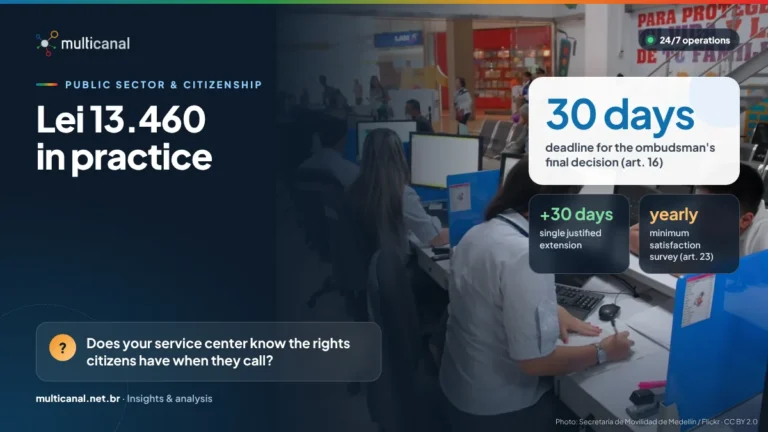
Lei 13.460/2017: what Brazil’s public service user code requires from customer service
Service Charter, ombudsman, 30-day deadline and satisfaction surveys: see what Brazil's Lei 13.460/2017 requires and how to bring these rules into a citizen service center.
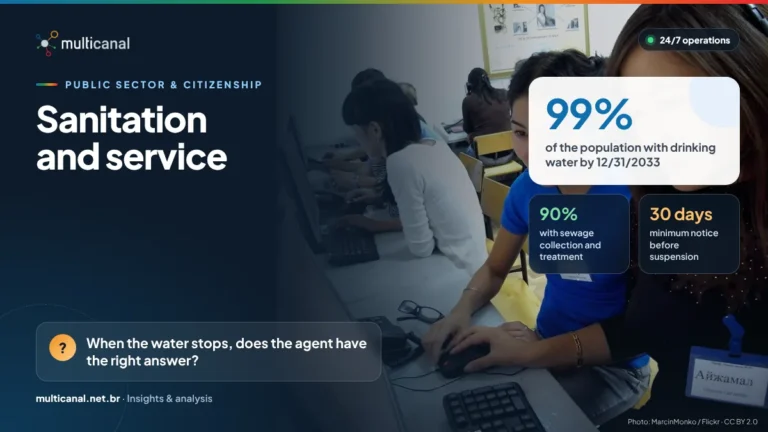
Sanitation contact centers: putting users at the heart of Brazil’s new legal framework
With targets of 99% water and 90% sewage coverage by 2033, Brazil's Sanitation Framework means more works, connections and contacts. What the law and ANA expect…
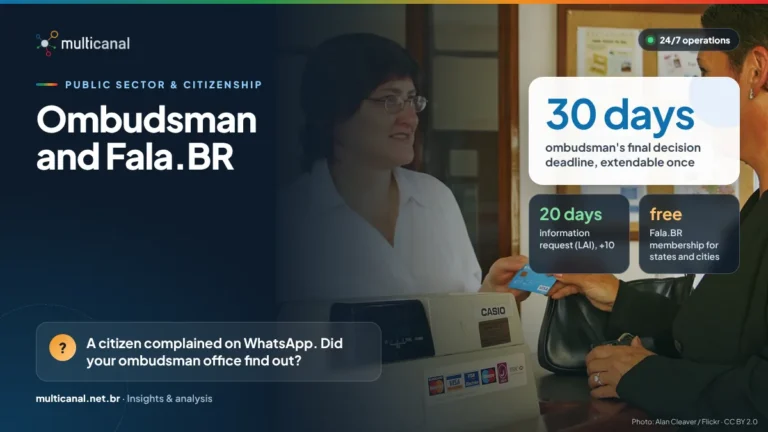
Public ombudsman offices and Fala.BR: how to integrate citizens’ feedback channels
Citizens complain by phone, WhatsApp, email or in person, but the ombudsman needs a single record. See how to connect the service center to Fala.BR and…