
Chatbots and generative AI in service: what to automate and what never to automate
Automation cuts waiting time and cost, but it has legal and practical limits. See where bots and generative AI help and where decisions must stay with a person.
Bots and generative AI models already answer questions, summarize conversations and suggest replies in real time. The gain is real, but the right question is not how much can be automated, but what can be automated without harming the customer or compliance. Getting this boundary wrong creates rework, complaints and legal risk.
Where automation works well
Automation pays off most for frequent, low-ambiguity requests with verifiable answers:
- status checks, duplicate bills, opening hours, addresses and ticket numbers;
- triage of the contact reason before transfer, without making access to an agent conditional on it;
- scheduling, reminders and confirmations;
- agent assist: knowledge base search, conversation summaries, suggested replies and after-call tagging.
Generative AI works best when it answers from controlled sources, such as a reviewed knowledge base, rather than from memory: language models can produce plausible but wrong answers.
What should never be left to the machine alone
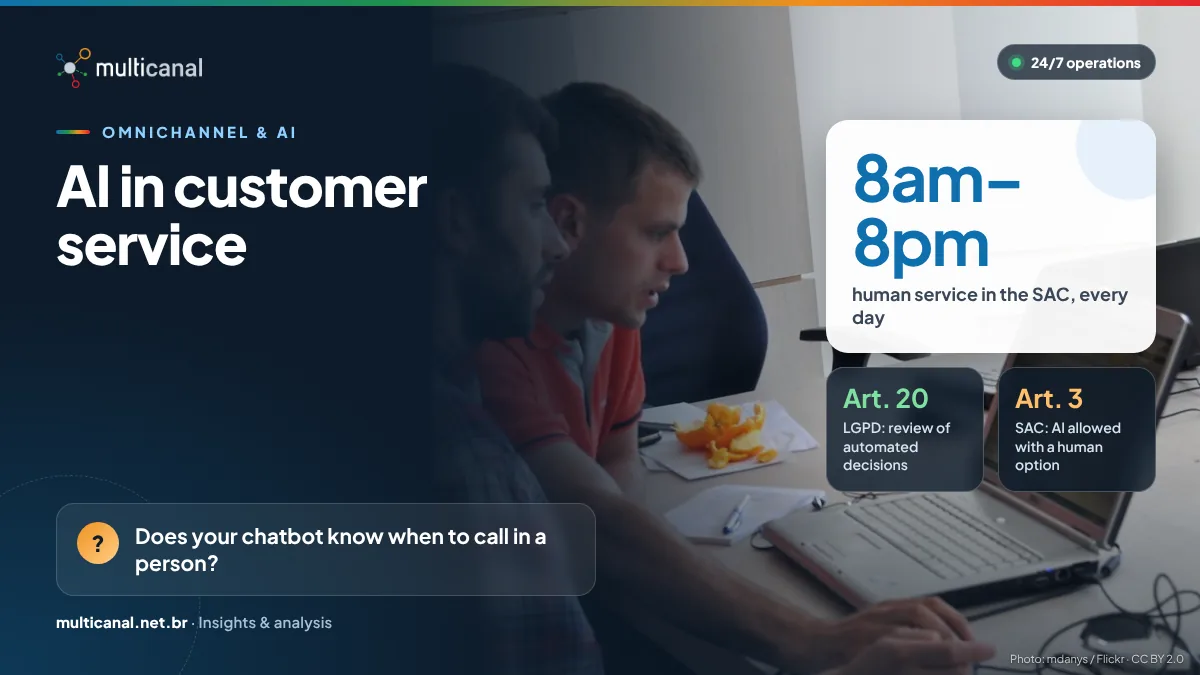
Brazil’s SAC regulation in force since November 2, 2026, Decree 13,135/2026 (Decreto 13.135/2026), allows automated procedures, including artificial intelligence, for triage, routing and resolution of requests, provided the consumer has the option of real-time service by a person (art. 3, § 3). Some situations call for a person in charge:
- Cancellation and asking for an agent: the decree requires, at every level of service, including the first, an immediate cancellation option and an option to talk to a person, available from 8 a.m. to 8 p.m. every day, by phone and on electronic channels (arts. 12 to 16);
- Decisions that affect rights, such as denying credit, disputes or service suspension: the LGPD (art. 20) gives data subjects the right to request review of decisions made solely on automated processing;
- Vulnerability, emergencies, health and safety: human listening and judgment are irreplaceable;
- When the customer asks for an agent: service by a person, when requested, is a guarantee of the SAC (art. 4, VIII), and WhatsApp’s policy also requires prompt and direct escalation paths.
Frictionless handoff and governance
The handoff from bot to person is the most sensitive point. The decree prohibits asking consumers to repeat a request already recorded, except for a justified technical reason (art. 6, II), and requires continuity until completion, without making them restart the service (art. 7): the agent must receive the history and context collected by the bot. Transparency (telling customers they are talking to a virtual assistant), testing before every change and monitoring samples of automated conversations also matter.
On the regulatory side, bill PL 2338/2023, which proposes a legal framework for artificial intelligence, was approved by the Senate in December 2024 and, in October 2026, was still awaiting a committee report in the Chamber of Deputies. Meanwhile, the Consumer Protection Code (CDC) and the LGPD already apply to any automated service and, for the suppliers it covers, so does the SAC Decree.
The first known chatbot, ELIZA, was described by Joseph Weizenbaum of MIT in a January 1966 paper in Communications of the ACM. It simulated a therapist using simple rules to rephrase sentences, and its creator later became a critic of the uncritical use of the technology.
References and legislation
- Decreto 13.135/2026 · Brazil’s current SAC regulation — access
- Decreto 11.034/2022 · previous SAC regulation, revoked — access
- Lei 13.709/2018 (LGPD) · art. 20, review of automated decisions — access
- PL 2338/2023 · bill for an AI legal framework, under review in the Chamber — access
- WhatsApp Business Messaging Policy · mandatory escalation to a human agent — access
In our experience, the best automation is the kind customers see as a shortcut, not a barrier. We start with agent assist and the simplest contact reasons, and only widen the bot’s scope with quality monitoring data in hand.
— Multicanal Content Team · Multicanal Contact CenterHow Multicanal helps: we design digital service flows in which automation handles the simple things and human teams, available 24/7, take over whatever requires judgment.
See digital serviceKeep reading
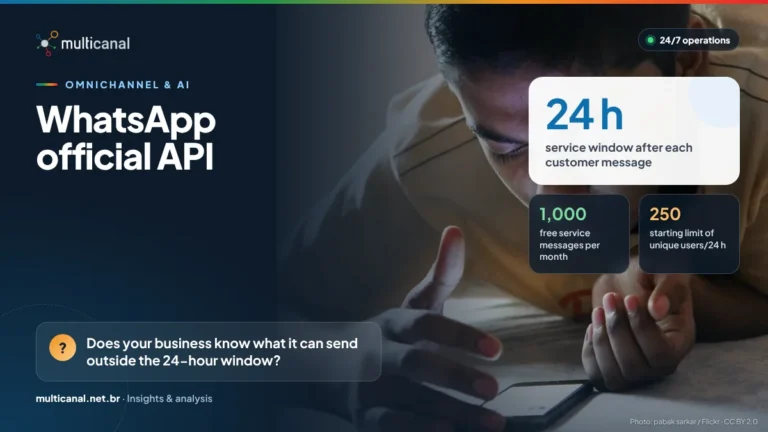
WhatsApp Business Platform: requirements, message templates and the 24-hour window
How WhatsApp's official API for businesses works: opt-in, approved templates, the 24-hour customer service window, messaging limits and the pricing in force since October 2026.
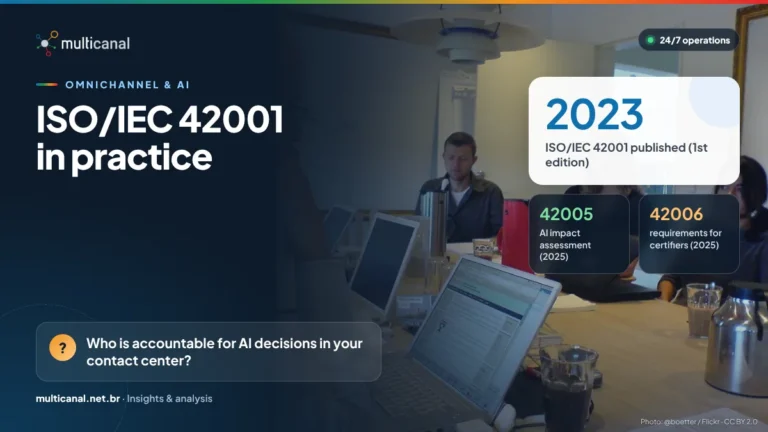
ISO/IEC 42001: applying AI governance to customer service
The international AI management system standard helps companies use chatbots, speech analytics and assistants with risk control, transparency and human oversight.
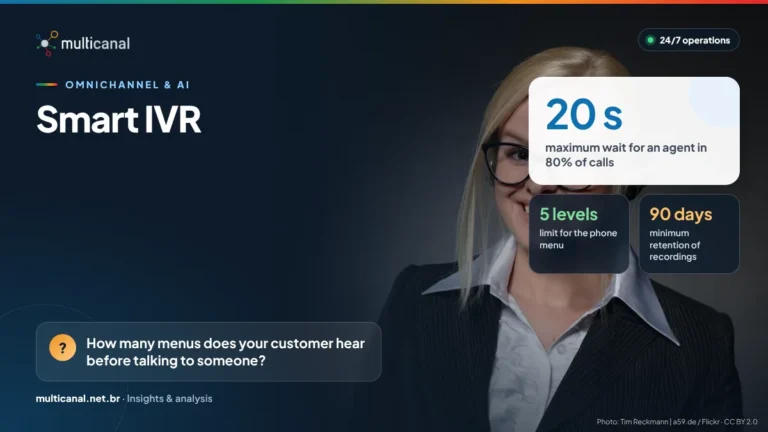
Smart IVR and speech recognition: less friction on the phone channel
Long menus and repeated requests drive customers away. See how natural-language IVR, Brazil's SAC Decree rules and care with voice biometrics reduce friction.