
Smart IVR and speech recognition: less friction on the phone channel
Long menus and repeated requests drive customers away. See how natural-language IVR, Brazil's SAC Decree rules and care with voice biometrics reduce friction.
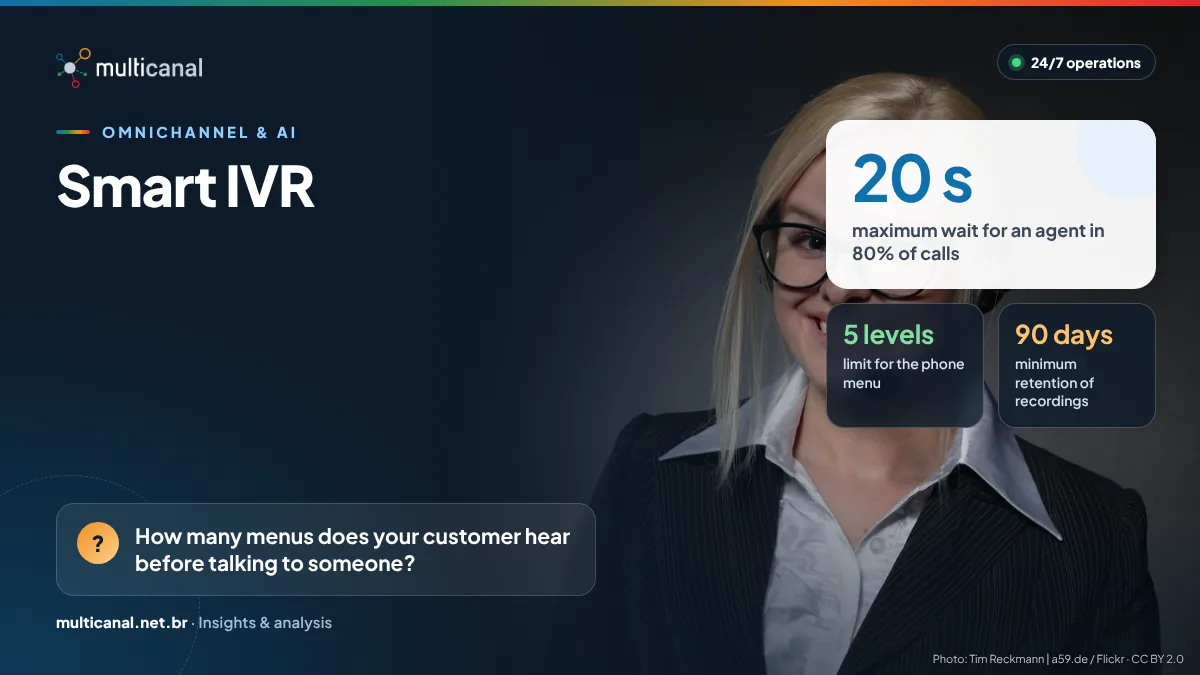
The phone is still the channel for people in a hurry or with a complicated problem, and that is where long menus, confusing options and repeated transfers frustrate the most. A smart IVR, with speech recognition and natural language, lets customers say what they need instead of memorizing numbers. Well designed, it reduces friction; poorly designed, it becomes a more sophisticated maze.
From keypad IVR to an IVR that understands
Traditional IVR works with keypad tones (DTMF): “press 1 for…”. A smart IVR adds automatic speech recognition and natural language processing to identify the contact reason from a free-form sentence, such as “I need a copy of my bill”. This makes it possible to:
- route the call straight to the right queue, without cascading menus;
- solve simple requests through self-service, such as duplicate bills and ticket status;
- identify the customer and pass that context to the agent;
- record contact reasons to analyze root causes and improve processes.
What Brazil’s new SAC Decree requires of the phone channel
Since November 2, 2026, customer service (SAC) in Brazil has been governed by Decree 13,135/2026 (Decreto 13.135/2026), which revoked Decree 11,034/2022. For the suppliers it covers (of services regulated by the federal executive branch, according to regulators’ criteria, and of digital financial services supervised by the Central Bank), the rules directly shape IVR design:
- human service from 8 a.m. to 8 p.m. every day, with the option to talk to a person at every menu level (arts. 14 and 15);
- a wait for an agent of up to 20 seconds for at least 80% of requests and up to 300 seconds for the rest, unless a sector-specific rule applies, with notice of the estimated wait (art. 15);
- no more than five levels to complete the request, without pushing the customer to another channel, and an immediate cancellation option at every level, including the first (art. 16);
- starting the service and transfer to an agent cannot depend on the consumer providing data first (art. 8);
- advertising messages are prohibited at any stage, including while waiting (art. 6, I);
- if the call with the agent drops, the supplier must call back within 300 seconds, using the information already provided (art. 14, § 3);
- recordings kept for at least 90 days (art. 19), and urgent requests handled immediately, at any time (art. 17).
Channels must also be accessible to people with disabilities (art. 10), and older people are entitled to priority service (art. 11). For IVR, this means offering alternatives for those who cannot use voice or keypad.
Voice biometrics: convenience with care
Recognizing what customers say is different from recognizing who is speaking. Voice biometrics speeds up authentication and helps prevent fraud, but the LGPD, Brazil’s data protection law, classifies biometric data as sensitive personal data (art. 5, II). Processing requires one of the legal bases in art. 11, such as specific and highlighted consent or fraud prevention in identification and authentication, plus transparency and stronger security. It is wise to offer an alternative to those who do not want to enroll their voice.
Tone dialing, the basis of keypad IVRs, was first offered commercially by the Bell System on November 18, 1963, in the towns of Carnegie and Greensburg, Pennsylvania (USA), under the Touch-Tone brand.
References and legislation
- Decreto 13.135/2026 · Brazil’s current SAC rules: menu, human service, waiting and recording — access
- Decreto 11.034/2022 · previous SAC regulation, revoked — access
- Lei 13.709/2018 (LGPD) · arts. 5 and 11, biometric data as sensitive data — access
- Lei 8.078/1990 (CDC) · Brazil’s Consumer Protection Code — access
Our rule of thumb: if customers have to listen to more than one menu to get what they want, the IVR is working for the company, not for them. Measuring abandonment by option and transfers is what allows the flow to be tuned continuously.
— Multicanal Content Team · Multicanal Contact CenterHow Multicanal helps: we run 24-hour inbound service with call recording, operational reports and workforce management (WFM), adjusting the phone flow to real demand.
Discover our contact centerKeep reading
WhatsApp Business Platform: requirements, message templates and the 24-hour window
How WhatsApp's official API for businesses works: opt-in, approved templates, the 24-hour customer service window, messaging limits and the pricing in force since October 2026.
Chatbots and generative AI in service: what to automate and what never to automate
Automation cuts waiting time and cost, but it has legal and practical limits. See where bots and generative AI help and where decisions must stay with…
ISO/IEC 42001: applying AI governance to customer service
The international AI management system standard helps companies use chatbots, speech analytics and assistants with risk control, transparency and human oversight.