
ISO/IEC 42001: applying AI governance to customer service
The international AI management system standard helps companies use chatbots, speech analytics and assistants with risk control, transparency and human oversight.
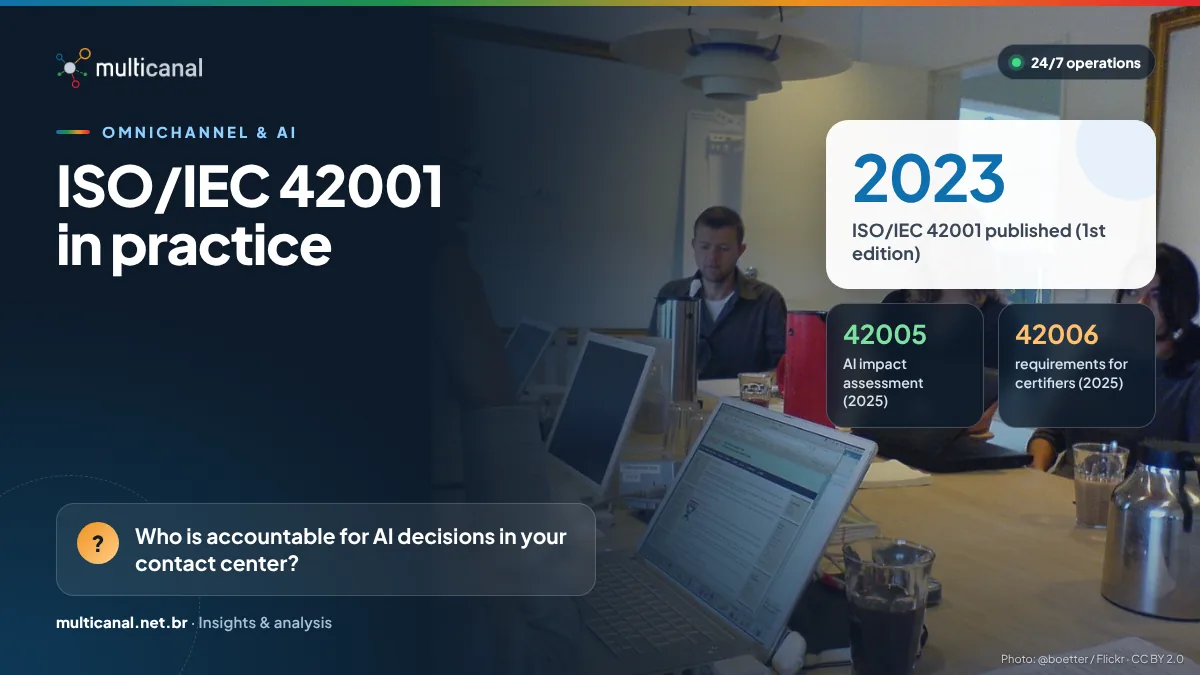
Virtual assistants, speech analytics, intelligent routing and automatic summaries are already part of many contact centers. Each of these uses makes or influences decisions about customers. ISO/IEC 42001 provides a framework to govern this: who is accountable for the AI, which risks have been assessed and how affected people are protected.
What ISO/IEC 42001 is
Published in December 2023 by ISO and IEC, ISO/IEC 42001 specifies requirements for establishing, implementing, maintaining and continually improving an artificial intelligence management system. It applies both to organizations that provide and to those that use AI-based products and services, which includes customer service companies that contract third-party models and platforms. In Brazil, ABNT published the national version, ABNT NBR ISO/IEC 42001:2024.
The standard follows the structure common to management system standards such as ISO/IEC 27001: context, leadership, planning, support, operation, performance evaluation and improvement. This makes it easier to integrate with existing information security and privacy systems.
How the controls apply to customer service
Annex A provides reference controls, selected according to each organization’s risks. In the contact center, some examples:
- Policy and roles: define who approves a new AI use, such as a collections bot or a sentiment classifier, and who is accountable for it;
- Impact assessment: analyze effects on customers, such as wrong contract information, bias in queue prioritization or data exposure, before going live; ISO/IEC 42005:2025 provides guidance for this assessment;
- Data for AI: know where the data feeding the system comes from, with quality and a legal basis compatible with Brazil’s LGPD;
- Information for interested parties: make clear to customers when they are interacting with an automated system and how to reach an agent;
- Responsible use and third parties: set usage limits, monitor performance and treat model and platform suppliers as part of the risk chain.
Where to start
A practical path is to inventory the AI uses in the operation, rank each one by its impact on customers, assess risks with the help of ISO/IEC 23894 (AI risk management) and define oversight indicators, such as the rate of transfer to humans, errors found in quality monitoring and complaints related to automation.
Certification is voluntary and carried out by certification bodies, which follow their own requirements published in ISO/IEC 42006:2025. And since Brazil’s AI legal framework (bill PL 2338/2023) was still under review in the Chamber of Deputies in October 2026, an internationally recognized management framework helps prepare the operation without waiting for the final text of the law.
According to ISO itself, ISO/IEC 42001 is the first international management system standard dedicated to artificial intelligence.
References and legislation
- ISO/IEC 42001:2023 · artificial intelligence management system — access
- ISO/IEC 42005:2025 · AI system impact assessment — access
- ISO/IEC 23894:2023 · guidance on AI risk management — access
- ISO/IEC 42006:2025 · requirements for audit and certification bodies — access
- Lei 13.709/2018 (LGPD) · Brazil’s General Personal Data Protection Law — access
We use third-party AI solutions as users and deployers, not as model developers, and that is exactly where governance matters: contracts, testing and human oversight. We are implementing ISO/IEC 42001 practices within our integrated management system.
— Multicanal Content Team · Multicanal Contact CenterHow Multicanal helps: Multicanal follows the standards of ISO 9001, ISO/IEC 27001, ISO/IEC 27701 and ISO 37001; AI governance is being implemented, with practices aligned with ISO/IEC 42001.
See standards and frameworksKeep reading
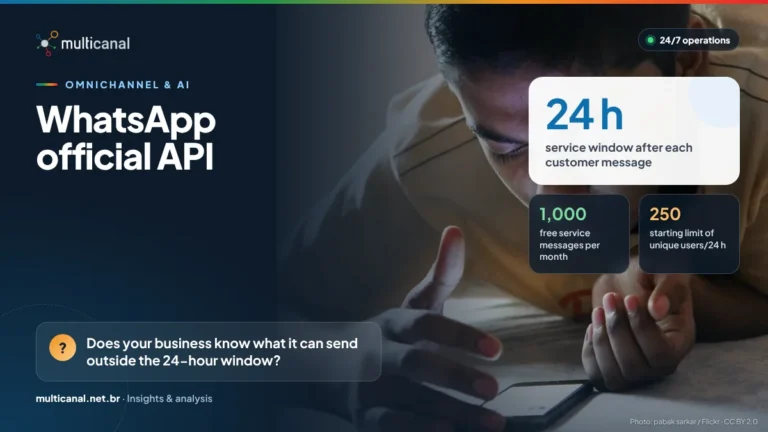
WhatsApp Business Platform: requirements, message templates and the 24-hour window
How WhatsApp's official API for businesses works: opt-in, approved templates, the 24-hour customer service window, messaging limits and the pricing in force since October 2026.
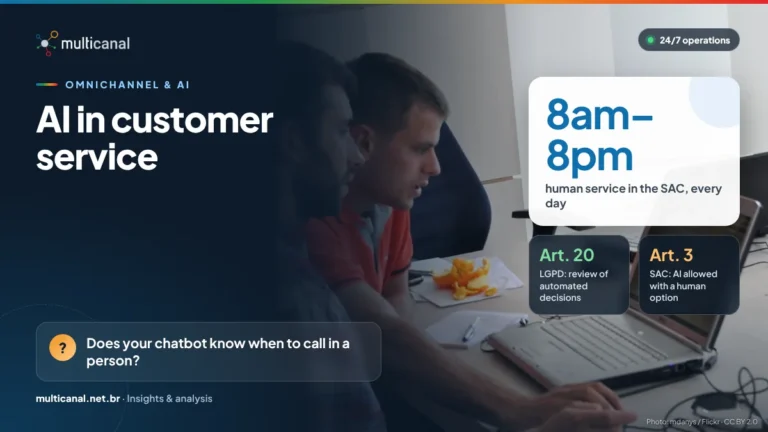
Chatbots and generative AI in service: what to automate and what never to automate
Automation cuts waiting time and cost, but it has legal and practical limits. See where bots and generative AI help and where decisions must stay with…
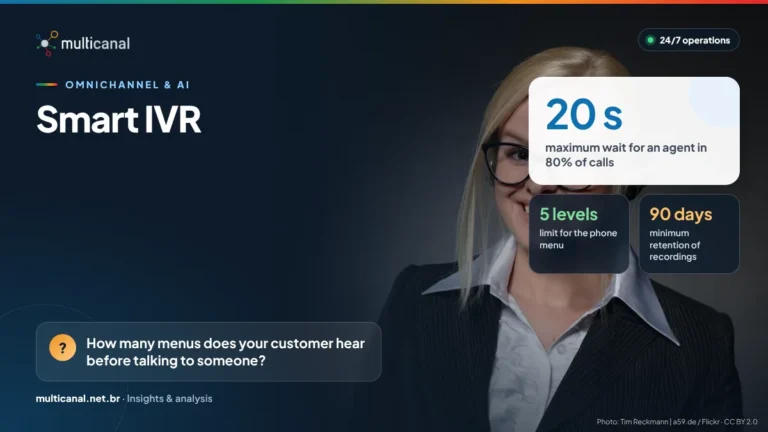
Smart IVR and speech recognition: less friction on the phone channel
Long menus and repeated requests drive customers away. See how natural-language IVR, Brazil's SAC Decree rules and care with voice biometrics reduce friction.