
Staffing with Erlang C: how many agents your operation really needs
Erlang C turns call volume and average handling time into a number of agents. See how the calculation works, a step-by-step example and where it falls short.
Too few agents create queues, abandonment and stress; too many cost a lot and sit idle. The Erlang C formula, created more than a century ago for telephone exchanges, is still the starting point for finding the balance — and it has gained extra relevance with the 20-second waiting rule in Brazil’s new customer service (SAC) decree.
Where Erlang comes from
Danish engineer Agner Krarup Erlang (1878–1929) worked at the Copenhagen Telephone Company when he published, in 1909 and 1917, studies applying probability theory to telephone traffic, including formulas for call loss and waiting time. From them come Erlang B, used for blocked calls, and Erlang C, for calls that wait in a queue. The unit of traffic intensity bears his name: 1 erlang equals one agent (or line) continuously busy during the period.
How the calculation works
Erlang C needs four inputs per interval, usually 30 minutes: forecast call volume, AHT (average handling time, adding talk, hold and after-call work), service level target and target answer time. First you calculate traffic load: volume × AHT ÷ interval length. Then the model estimates, for each number of agents, the probability that a call will wait and the percentage answered within the target time.
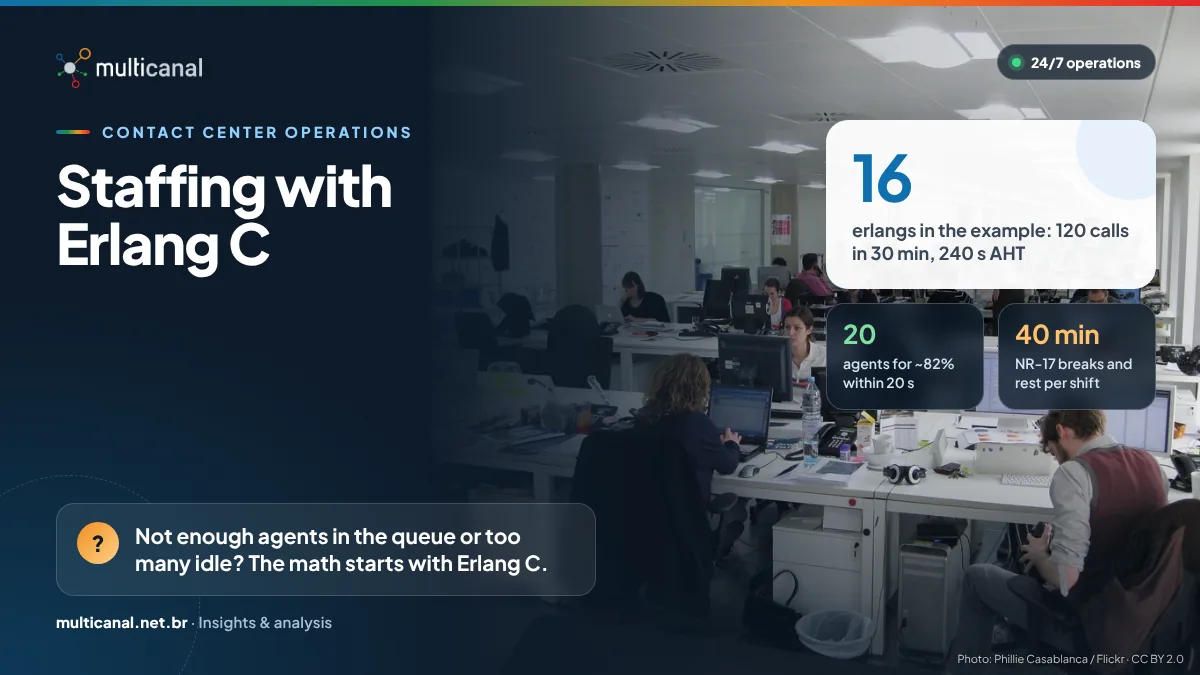
Example: 120 calls in 30 minutes with a 240-second AHT generate 120 × 240 ÷ 1,800 = 16 erlangs. Under Erlang C, 19 agents would answer about 71% of calls within 20 seconds; with 20, about 82%, with an average wait of roughly 15 seconds and 80% occupancy. A single extra agent changes the result disproportionately: the relationship between staff and queue is not linear.
From seats to schedules: what Erlang leaves out
The calculated number refers to agents logged in and available during the interval. To build the schedule, you must add shrinkage: mandatory breaks, training, feedback sessions, absenteeism and holidays. In Brazilian teleservice, Annex II of NR-17 (the national ergonomics standard) provides two 10-minute breaks and a 20-minute rest period in shifts of up to six hours — 40 minutes away from the seat per person. The model also relies on assumptions that reality does not always respect:
- It assumes nobody abandons the queue; with significant abandonment, it tends to overestimate the staff needed.
- It treats calls as independent and AHT as stable, which fails during peaks caused by campaigns or incidents.
- It does not represent concurrent channels well, such as chat with several conversations per agent.
That is why Erlang C is the starting point; calibration comes from history, simulation and interval-by-interval tracking by workforce management (WFM).
The unit of telephone traffic was officially named the “erlang” in October 1946, at a meeting in Montreal of the international consultative committee for long-distance telephone communications — a tribute to the Danish engineer, who died in 1929.
References and legislation
- MacTutor History of Mathematics · biography of Agner Krarup Erlang (University of St Andrews) — access
- NR-17, Anexo II · Brazilian teleservice rules: hours, breaks and staffing levels (item 6.2) — access
- Decreto nº 13.135/2026 · Brazil’s SAC decree: wait of up to 20 s for 80% of requests (art. 15) — access
We use Erlang C as a yardstick, not as the final answer. The difference between an operation that meets its service level and one that keeps firefighting lies in interval-by-interval tracking and constant review of volume and AHT forecasts.
— Multicanal Content Team · Multicanal Contact CenterHow Multicanal helps: our operation relies on workforce management (WFM) to size teams by interval, plan 24/7 schedules and track service levels throughout the day.
Explore our contact centerKeep reading
80/20 service level, AHT and ASA: how to read contact center KPIs without fooling yourself
80/20 has become law under Brazil's new SAC decree. Learn how to calculate service level, AHT and ASA, why averages hide queues and which dashboard traps…
NR-17 Annex II: ergonomics, breaks and working hours in Brazil’s teleservice, item by item
A 6-hour day, two 10-minute breaks, individual headsets, adjustable furniture and limits on performance pressure: what Annex II of Brazil's NR-17 requires from teleservice.
Quality monitoring: from punitive checklists to coaching that improves results
Monitoring that only points out mistakes breeds fear and memorised scripts. See how to redesign forms, calibration and feedback so evaluation becomes learning — within Brazil's…