
80/20 service level, AHT and ASA: how to read contact center KPIs without fooling yourself
80/20 has become law under Brazil's new SAC decree. Learn how to calculate service level, AHT and ASA, why averages hide queues and which dashboard traps to avoid.
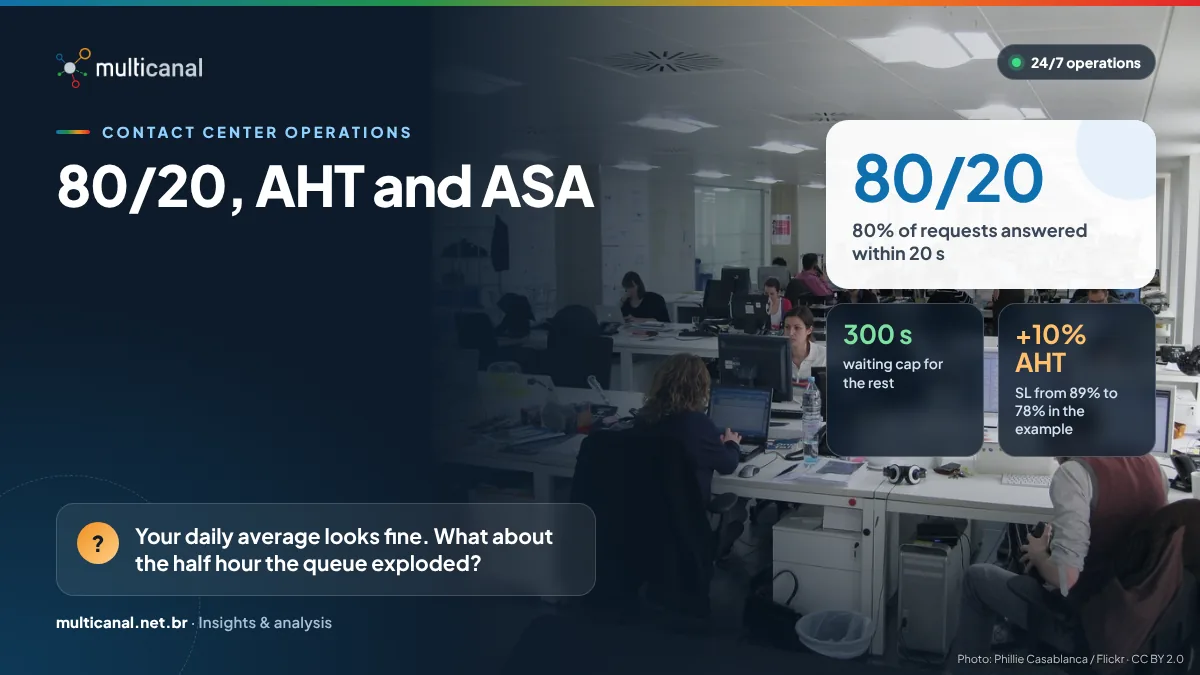
For a long time, “80/20” — answering 80% of calls within 20 seconds — was a market benchmark. With Brazil’s Decree 13.135/2026, it became a rule for customer service (SAC) in the covered sectors, with a 300-second cap for the remaining requests. That makes it essential to read service level, AHT and ASA correctly, because well-presented averages hide long queues.
What each metric measures
- Service level (SL): the percentage of calls answered within the target time; in 80/20, the goal is 80% within 20 seconds. There are different formulas — with or without abandoned calls in the denominator, excluding very short abandons or not — and the choice changes the number. Put it in writing.
- ASA (average speed of answer, “TME” in Brazil): how long customers wait, on average, until answered. Because it is an average, it can look low even when some customers wait a long time.
- AHT (average handling time, “TMA” in Brazil): talk + hold + after-call work. It is a sizing input, not a productivity target.
What the decree now requires
When consumers choose to talk to a person, the maximum wait is up to 20 seconds for at least 80% of answered requests and up to 300 seconds for the rest (art. 15, I). The general rule does not apply when the sector’s regulatory agency has a specific rule (§ 1), and customers must be told the estimated waiting time (§ 2). The previous decree, 11.034/2022, did not set these numbers: it left them to regulators. Two practical points: the text refers to answered requests, so align with your legal team on how to treat abandoned calls in the calculation; and the 300-second cap looks at the tail of the queue — a good average is not enough.
Common reading traps
- The daily average hides the peak: one interval with 200 calls at 95% and another with 100 calls at 50% add up to exactly 80% for the day — and half the customers in the second interval waited more than 20 seconds. Track by 15- or 30-minute interval.
- AHT as an individual target: pressuring agents to hang up quickly generates repeat contacts and hurts resolution. Moreover, NR-17, Brazil’s ergonomics standard, forbids using productivity-monitoring mechanisms, such as call-time or queue indicators, to speed up work (Annex II, item 6.9).
- Small changes, big effects: in an example calculated with Erlang C — 100 calls per half hour and 14 agents —, a 10% increase in AHT, from 180 to 198 seconds, drops the service level from about 89% to 78% and raises ASA from 8 to 20 seconds.
- Looking only at voice: the decree also guarantees real-time human service on electronic channels, and regulators may set waiting parameters for them (art. 12, § 3).
The same 300 seconds appear elsewhere in the new decree: it is the deadline for the company to call back when a human-handled call drops before completion, using the information already provided and giving the protocol number (art. 14, § 3).
References and legislation
- Decreto nº 13.135/2026 · Brazil’s SAC decree: 20 s/300 s maximum waiting time (art. 15) — access
- Decreto nº 11.034/2022 · previous regulation, revoked; waits set by regulators (art. 5) — access
- NR-17, Anexo II · teleservice: use of time and queue indicators (item 6.9) — access
We suggest a dashboard with few numbers, always by interval: service level, abandonment, longest wait and AHT with its trend. The daily average is for reports; staffing decisions are made looking at each half hour.
— Multicanal Content Team · Multicanal Contact CenterHow Multicanal helps: we size and monitor operations with workforce management (WFM) and interval-based operational reports, to keep the service level within the contracted target and Brazil’s SAC rules.
Explore our contact centerKeep reading
Staffing with Erlang C: how many agents your operation really needs
Erlang C turns call volume and average handling time into a number of agents. See how the calculation works, a step-by-step example and where it falls…
NR-17 Annex II: ergonomics, breaks and working hours in Brazil’s teleservice, item by item
A 6-hour day, two 10-minute breaks, individual headsets, adjustable furniture and limits on performance pressure: what Annex II of Brazil's NR-17 requires from teleservice.
Quality monitoring: from punitive checklists to coaching that improves results
Monitoring that only points out mistakes breeds fear and memorised scripts. See how to redesign forms, calibration and feedback so evaluation becomes learning — within Brazil's…