
Quality monitoring: from punitive checklists to coaching that improves results
Monitoring that only points out mistakes breeds fear and memorised scripts. See how to redesign forms, calibration and feedback so evaluation becomes learning — within Brazil's NR-17.
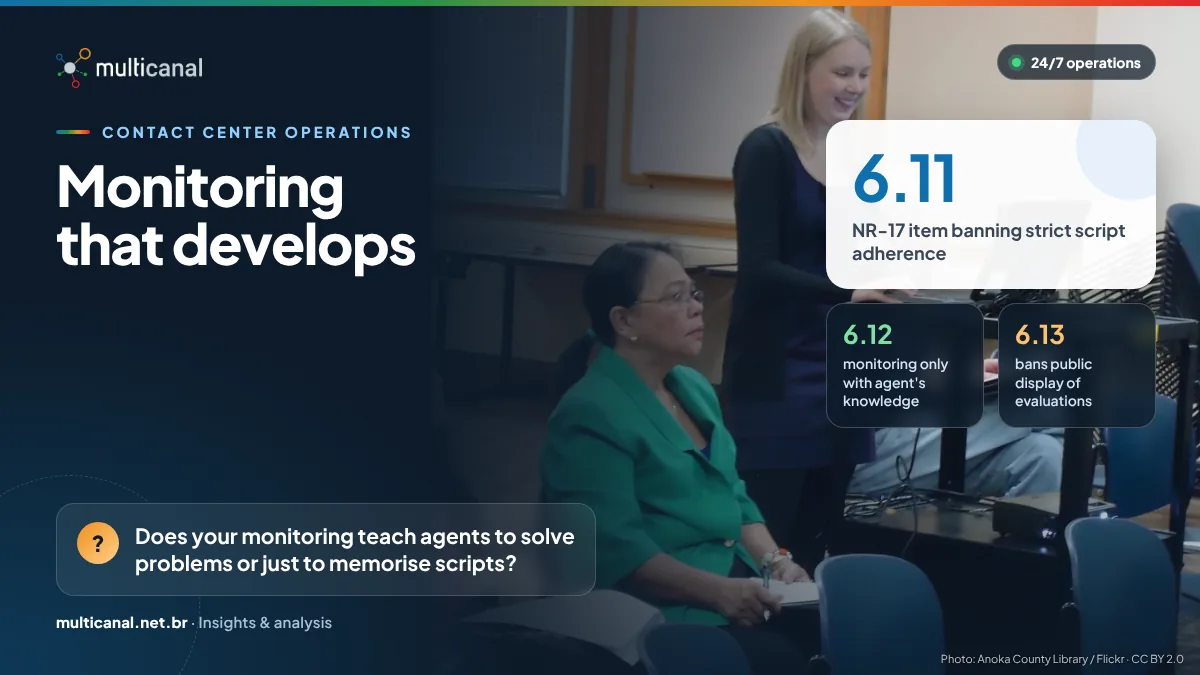
In many operations, quality monitoring has become a hunt for mistakes: a spreadsheet with dozens of items, a score at month-end and little conversation. The result is usually agents memorising scripts and customers left without solutions. Good monitoring does the opposite: it uses listening to understand what works, fix what gets stuck and develop people.
Why punitive checklists don’t work
Long forms that give the same weight to “said the company name” and “solved the problem” reward form over results. When the score mostly serves to punish, agents protect themselves: they follow the script to the letter, avoid decisions and transfer more. There are also legal limits. Annex II of NR-17, Brazil’s ergonomics standard for teleservice, forbids requiring strict adherence to scripts (item 6.11), prohibits public display of performance evaluations and abusive competition (item 6.13) and requires monitoring by listening and recording to take place with the agent’s knowledge (item 6.12).
How to redesign monitoring
- A lean, results-oriented form: few criteria, grouped into resolution, accuracy of information, legal and data protection compliance, and customer experience. Critical failures — wrong information, exposure of personal data, improper promises — handled separately.
- Regular calibration: monitors, supervisors and, where possible, the client company assess the same interactions and compare scores until differences between evaluators shrink.
- A representative sample: interactions from different channels, times and reasons; speech analytics helps find relevant cases but does not replace skilled listening.
- Link to KPIs: cross the score with first contact resolution, repeat contacts and satisfaction to check whether the form measures what matters to customers.
From feedback to coaching
Feedback says what happened; coaching helps the person discover how to do better. In practice, it works in short, frequent, one-on-one private sessions based on a real interaction: the agent listens to the recording, points out what they would do differently, agrees on a single improvement focus, and the supervisor follows progress over the next weeks. It is also worth highlighting good interactions — they become training material for the whole team.
This cycle is in line with what ISO 9001 asks regarding competence and continual improvement and with the service requirements of ISO 18295-1:2017 for customer contact centres. And remember: Annex II of NR-17 also provides a break after calls involving verbal abuse or aggression (item 6.4.5) — coaching should not happen right after a draining call.
The word coach comes from the Hungarian kocsi, the carriage made in the village of Kocs. Around 1830, Oxford students began calling a private tutor who “carried” a student through exams a coach — the origin of the sense of someone who takes people from where they are to where they want to go.
References and legislation
- NR-17, Anexo II · Brazilian teleservice rules: scripts, monitoring and evaluations (items 6.11–6.13) — access
- ISO 18295-1:2017 · service requirements for customer contact centres — access
- Online Etymology Dictionary · origin of the word coach — access
For us, good monitoring is monitoring agents want to receive. When the conversation starts from a real interaction, focuses on one point at a time and recognises what went well, the score stops being a threat and becomes a tool.
— Multicanal Content Team · Multicanal Contact CenterHow Multicanal helps: we support ongoing training for customer service teams, with courses and quality follow-up focused on resolution and customer experience — under management that follows the standards of ISO 9001.
Explore training and developmentKeep reading
Staffing with Erlang C: how many agents your operation really needs
Erlang C turns call volume and average handling time into a number of agents. See how the calculation works, a step-by-step example and where it falls…
80/20 service level, AHT and ASA: how to read contact center KPIs without fooling yourself
80/20 has become law under Brazil's new SAC decree. Learn how to calculate service level, AHT and ASA, why averages hide queues and which dashboard traps…
NR-17 Annex II: ergonomics, breaks and working hours in Brazil’s teleservice, item by item
A 6-hour day, two 10-minute breaks, individual headsets, adjustable furniture and limits on performance pressure: what Annex II of Brazil's NR-17 requires from teleservice.