
NR-17 Annex II: ergonomics, breaks and working hours in Brazil’s teleservice, item by item
A 6-hour day, two 10-minute breaks, individual headsets, adjustable furniture and limits on performance pressure: what Annex II of Brazil's NR-17 requires from teleservice.
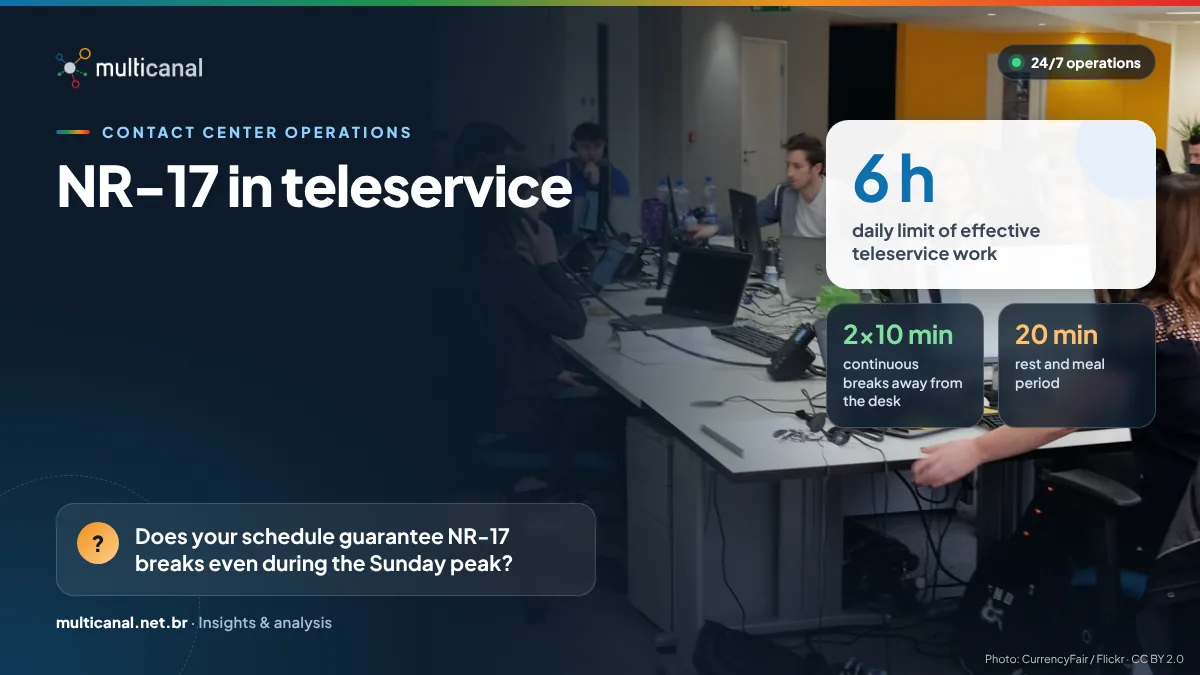
Teleservice has its own ergonomics standard in Brazil: Annex II of NR-17, as worded by Ordinance MTP No. 423/2021. It sets working hours, breaks, furniture, equipment, environment and even limits on how results are demanded. For anyone hiring or running a contact center, knowing these items is a matter of health, legal certainty and service quality.
Working hours and breaks
- Effective teleservice working time of no more than 6 hours a day, breaks included, with a limit of 36 hours a week (items 6.3 and 6.3.1).
- Two continuous 10-minute breaks, away from the workstation, after the first and before the last 60 minutes of work (item 6.4.1); shifts of up to 4 hours have one 10-minute break (item 6.4.3).
- A 20-minute rest and meal period (item 6.4.2).
- Breaks recorded in print or electronically, with workers having access to their own records (item 6.4.4).
- A break guaranteed right after calls involving threats, verbal abuse or aggression (item 6.4.5).
- Leaving the workstation for physiological needs at any time, with no impact on evaluations or pay (item 6.7).
Staffing must be sized to avoid habitual overload and to let everyone take their breaks (items 6.2 and 6.2.1). Work on Sundays and holidays requires prior authorisation from the competent authority under article 68 of the CLT (Brazil’s labour code), or a legal provision, and in authorised cases at least one Sunday off per month is guaranteed (items 6.1 and 6.1.1) — a sensitive point now that the new customer service (SAC) decree requires human service seven days a week.
Workstation and environment
The Annex details furniture: monitor and keyboard with independent adjustments, height-adjustable work surface, five-leg chair with casters, adjustable backrest and armrests (item 3.1). It requires individual headsets provided free of charge, with volume control and protection against acoustic shock, replaced when faulty or worn (item 4.1). The environment needs adequate acoustics and thermal comfort and must comply with indoor air quality rules for air-conditioned spaces (items 5.1 to 5.3). New technologies that change the way people work require a preliminary ergonomic assessment or ergonomic work analysis (AET) before rollout (item 4.4).
Work organisation and training
The standard forbids requiring strict adherence to scripts (item 6.11), prohibits methods that cause moral harassment, fear or embarrassment — such as abusive competition and public display of evaluations (item 6.13) — and prevents time and queue displays from being used to speed up work (item 6.9). Monitoring by listening and recording may only occur with the agent’s knowledge (item 6.12). All workers, including temporary staff, receive training on risks and prevention: 4 hours on hiring and refresher training every 6 months, during working hours (item 7.1.2.1).
Annex II states that service scripts must not require agents to give customers their surname, to protect their privacy and personal safety (item 6.16).
References and legislation
- NR-17, Anexo II · teleservice/telemarketing work — updated text (gov.br) — access
- NR-17 — Ergonomia · official page of the standard and amendment history (Brazil’s Labour Ministry) — access
- Decreto nº 13.135/2026 · Brazil’s SAC decree: human service 8 a.m.–8 p.m., seven days a week — access
We treat Annex II as part of operation design, not as an audit checklist. Schedules that respect breaks, well-adjusted workstations and targets compatible with the available time tend to reduce sick leave and show up directly in service quality.
— Multicanal Content Team · Multicanal Contact CenterHow Multicanal helps: we provide contact center seat infrastructure — facilities, generator set, UPS units and IT equipment supply — for teleservice operations planned with ergonomics in mind.
Explore our infrastructureKeep reading
Staffing with Erlang C: how many agents your operation really needs
Erlang C turns call volume and average handling time into a number of agents. See how the calculation works, a step-by-step example and where it falls…
80/20 service level, AHT and ASA: how to read contact center KPIs without fooling yourself
80/20 has become law under Brazil's new SAC decree. Learn how to calculate service level, AHT and ASA, why averages hide queues and which dashboard traps…
Quality monitoring: from punitive checklists to coaching that improves results
Monitoring that only points out mistakes breeds fear and memorised scripts. See how to redesign forms, calibration and feedback so evaluation becomes learning — within Brazil's…