
Digital government (Lei 14.129/2021): why citizen service remains multichannel
Brazil's Digital Government Law prioritizes self-service but preserves in-person service and requires accessibility. See the role of service centers in this transition.
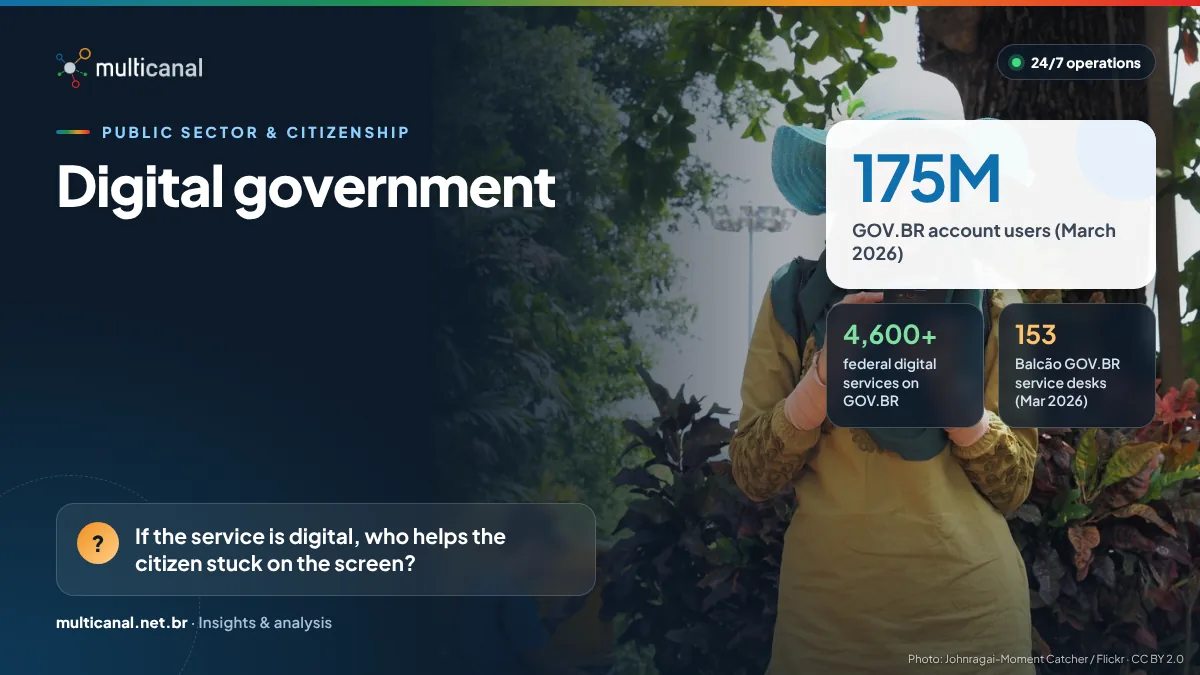
The GOV.BR account reached 175 million users in March 2026, according to Brazil’s Ministry of Management and Innovation in Public Services, with access to more than 4,600 federal digital services. Lei 14.129/2021, the Digital Government Law, drives this transformation but does not order other channels to be shut down: it calls for widely accessible digital services without prejudice to in-person service. It is in this middle ground that the service center takes on a new role.
What the law establishes
The law applies to the federal administration and to States and Municipalities that adopt it through their own regulations (art. 2, III). Its principles include a single platform for access to information and services, without prejudice to in-person service when essential; clear language; keeping the option of in-person service according to the target audience; accessibility for people with disabilities; and digital inclusion (art. 3, II, VII, XVI, XIX and XX). Digital delivery must use widely accessible technologies, including for low-income people and those in rural and isolated areas, preferably through self-service (art. 14).
Digital Government Platforms must offer a request and tracking tool with scheduling, step-by-step tracking, ongoing satisfaction assessment, notifications, digital payment and an ombudsman system under Lei 13.460 (arts. 20 and 21). Users are entitled to free access to the platforms, a ticket number for their requests and the choice of a preferred channel for communications (art. 27).
Where human service comes in
Not every citizen has a connection, a device or familiarity with apps, and even those who do sometimes get stuck at a step. The federal government itself runs Balcão GOV.BR, with 153 in-person help desks in 17 states as of March 2026. The service center complements this design:
- it helps complete the digital service instead of replacing it;
- it offers assisted channels — phone, WhatsApp, chat — with the same information as the Service Charter;
- it records a ticket number and returns citizens to self-service whenever possible;
- it turns contact reasons into improvements for the platforms.
A roadmap for municipalities
- adopt the law through a local act and, if desired, issue a local digital government strategy (arts. 2 and 16);
- keep the Service Charter up to date and make it available in the National Public Services Base;
- unify ticket numbers across digital, phone and in-person channels;
- measure satisfaction continuously and act on the results;
- ensure transparency in personal data processing (art. 25) and accessibility.
This is the kind of challenge Multicanal follows at the Citizen Service Center of the General Ombudsman Office of the Municipality of Boa Vista, Roraima (Contract No. 970/2026, in force from 10/02/2026 to 10/01/2027).
Lei 14.129/2021 came into force on different dates: 90 days after publication for the Federal Government, 120 days for the States and the Federal District, and 180 days for Municipalities (art. 55).
References and legislation
- Lei 14.129/2021 · principles, rules and instruments of Digital Government (updated text, in Portuguese) — access
- Lei 13.460/2017 · rights of public service users and the Service Charter (in Portuguese) — access
- MGI — GOV.BR reaches 175 million users · users, services and Balcão GOV.BR data, 03/24/2026 (in Portuguese) — access
As we see it, digital and human do not compete: good citizen service uses human contact to unlock the digital channel and digital data to reduce the need for contact. Measuring both together closes the loop.
— Multicanal Content Team · Multicanal Contact CenterHow Multicanal helps: our OMNI CHANNEL platform integrates WhatsApp Business through Meta’s official flow, chat, email and voice, with a single ticket number and reports for public management.
Discover omnichannel serviceKeep reading
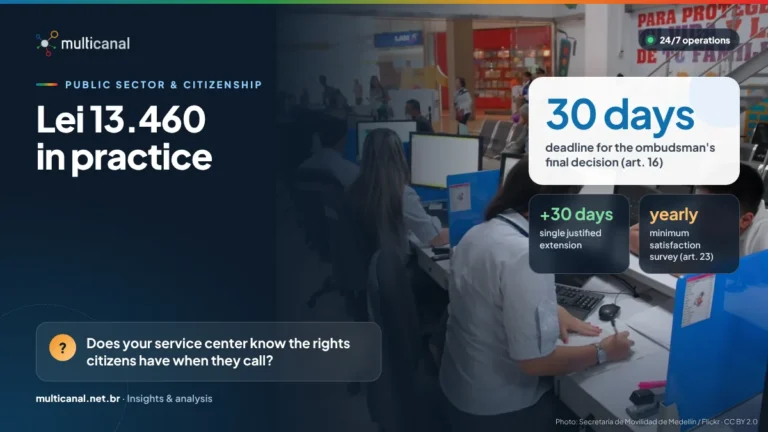
Lei 13.460/2017: what Brazil’s public service user code requires from customer service
Service Charter, ombudsman, 30-day deadline and satisfaction surveys: see what Brazil's Lei 13.460/2017 requires and how to bring these rules into a citizen service center.
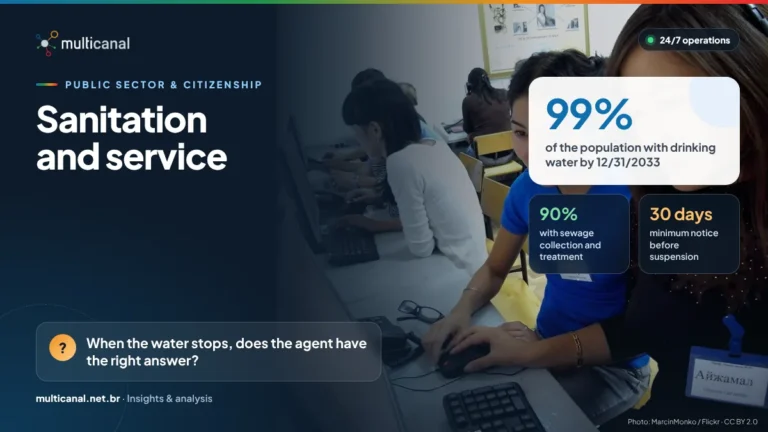
Sanitation contact centers: putting users at the heart of Brazil’s new legal framework
With targets of 99% water and 90% sewage coverage by 2033, Brazil's Sanitation Framework means more works, connections and contacts. What the law and ANA expect…
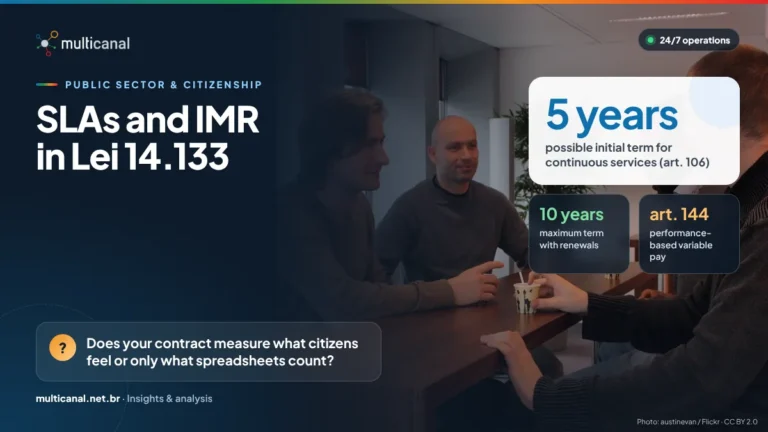
Lei 14.133/2021: how to procure contact center and IT services with SLAs and IMR that work
Brazil's new Procurement Law favors results-based contracts. See how to design service levels and an IMR for contact centers and service desks that measure what matters.