
Omnichannel vs. multichannel: why an integrated history changes customer service
Having many channels is not enough: without an integrated history, customers repeat their story every time. Learn the difference and what Brazil's SAC Decree requires.
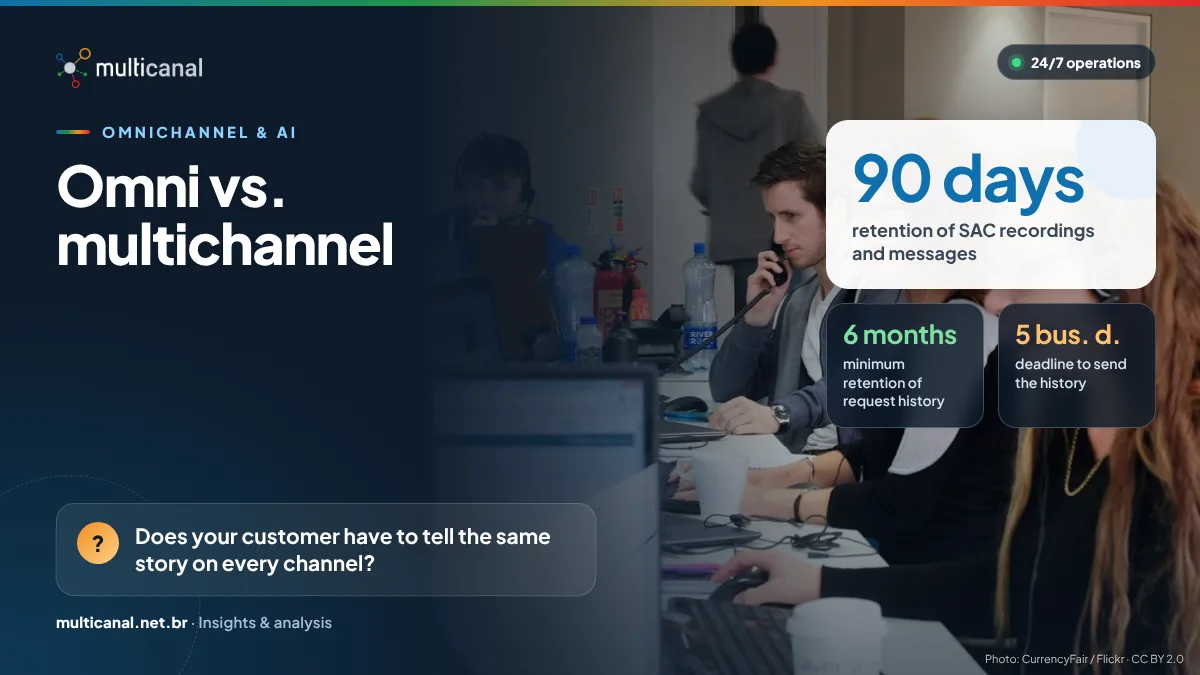
Phone, WhatsApp, email, website chat, social media: offering many channels has become the bare minimum. The problem starts when each channel works like an island: the customer explains the case in the chat, calls the next day and has to tell everything again. That is exactly the difference between multichannel and omnichannel: not the number of channels, but the continuity of the conversation.
The difference in practice
In the multichannel model, the company is present on several channels, but each has its own queues, records and often its own systems. In omnichannel, channels share the same history, the same ticket number and the same customer record: the phone agent sees what was said on WhatsApp, and a case can start in one channel and end in another without starting over.
- Identification: in multichannel, customers identify themselves at every contact; in omnichannel, the record and context follow the customer;
- Ticket: one number per channel versus a single record of the request, trackable in any channel;
- Metrics: isolated per-channel metrics versus a journey view, including how many contacts it took to resolve;
- Management: separate schedules and queues versus a workforce allocated according to total demand.
What regulation already requires
Brazil’s Decree 13,135/2026 (Decreto 13.135/2026), which has governed customer service (SAC) since November 2, 2026 and revoked Decree 11,034/2022, reinforces continuity across channels:
- consumers can track all their requests, across the SAC channels, through a ticket number or another electronic procedure that generates a protocol (art. 18);
- the system must give agents access to the history of active requests or those related to the same event or contract (art. 18, § 1);
- the supplier must follow the request through to completion, without requiring the consumer to restart the service or make new contacts (art. 7), and cannot ask them to repeat a request already recorded, except for a justified technical reason (art. 6, II);
- on the phone and on electronic channels, sending the customer to another channel to complete the request is prohibited, except to in-person service when indispensable (arts. 13 and 16);
- the history must be sent, upon request, within five business days and kept for at least six months after resolution (art. 18, § 4); recordings and voice or text messages are kept for 90 days (art. 19).
Even for companies outside the decree’s scope, these rules are a good quality benchmark.
How to reach a single customer view
Integration starts with data, not tools: a unique customer identifier, a common model for recording requests (reason, status, source channel, answer) and integration with CRM and back-office systems. Then come the rules: how a case moves between channels, who owns it and which indicators measure the entire journey.
Because the history concentrates personal data, access must follow the necessity and security principles of the LGPD, Brazil’s data protection law: each agent sees what is needed to solve the case, and nothing more.
Under the new decree, an electronic SAC channel is any means other than a phone call, by voice, text or video, that allows real-time interaction with a person, even if only during part of its hours, including website and app chats and instant messaging services (art. 3, § 2).
References and legislation
- Decreto 13.135/2026 · Brazil’s current SAC rules: tickets, history and deadlines — access
- Decreto 11.034/2022 · previous SAC regulation, revoked — access
- Lei 13.709/2018 (LGPD) · necessity and security principles — access
- Lei 8.078/1990 (CDC) · Brazil’s Consumer Protection Code — access
When we assess an operation, the first question is simple: can the agent see, on one screen, everything the customer has already done? If the answer is no, the problem is not the channel but integration, and that is where we start.
— Multicanal Content Team · Multicanal Contact CenterHow Multicanal helps: we offer digital and omnichannel service with our own OMNI CHANNEL / App Multicanal platform, CRM and operational reports to follow the customer journey end to end.
See omnichannel serviceKeep reading
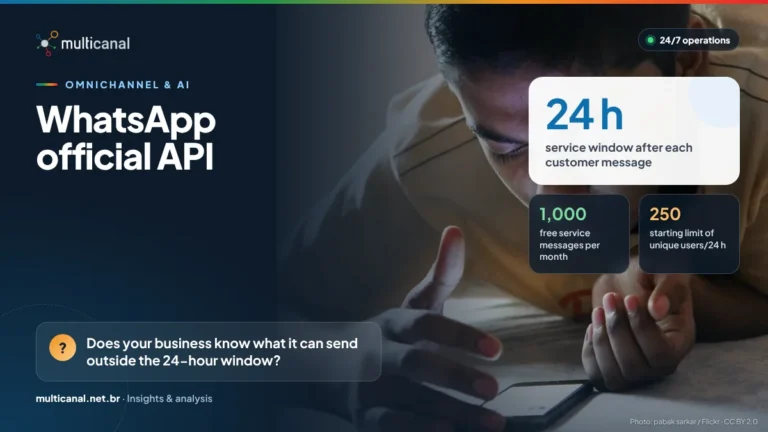
WhatsApp Business Platform: requirements, message templates and the 24-hour window
How WhatsApp's official API for businesses works: opt-in, approved templates, the 24-hour customer service window, messaging limits and the pricing in force since October 2026.
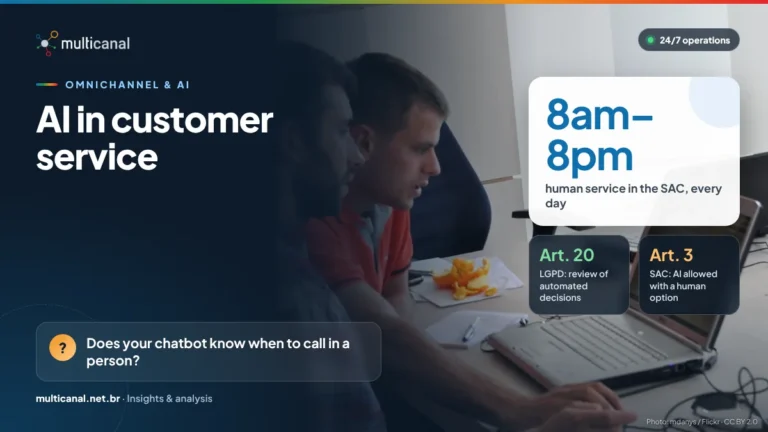
Chatbots and generative AI in service: what to automate and what never to automate
Automation cuts waiting time and cost, but it has legal and practical limits. See where bots and generative AI help and where decisions must stay with…
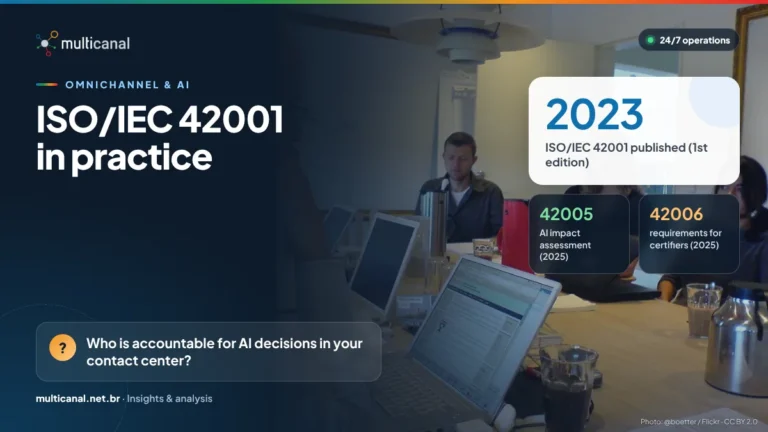
ISO/IEC 42001: applying AI governance to customer service
The international AI management system standard helps companies use chatbots, speech analytics and assistants with risk control, transparency and human oversight.