
Uninterrupted 24/7 operations: redundancy, generators, UPS and ISO 22301
Power cuts, link failures or system outages cannot stop customer service. See how redundancy, power and business continuity management support a 24/7 operation.
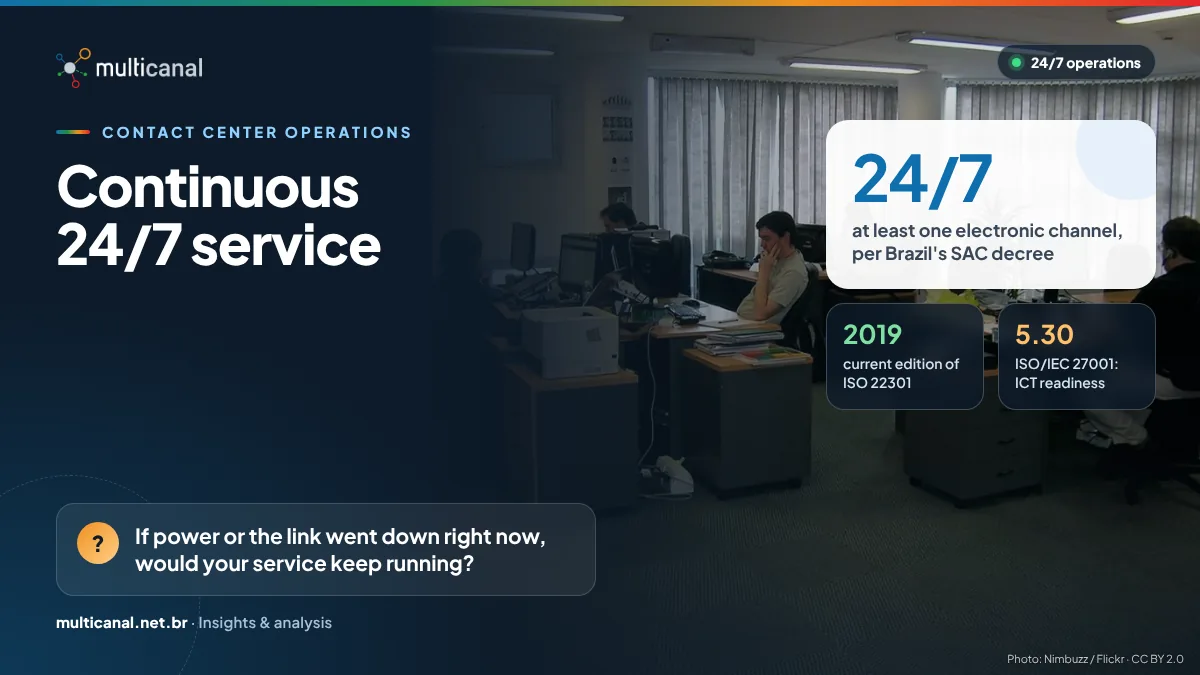
For a center serving essential services, minutes offline mean lost calls, unanswered customers and contractual risk. Brazil’s new customer service (SAC) decree requires at least one electronic channel running 24 hours and human service from 8 a.m. to 8 p.m. every day. Meeting that takes more than equipment: it takes planned redundancy and a business continuity management system.
A contact center’s single points of failure
An operation depends on a chain: power, air conditioning, local network, data and voice links, telephony, service platforms (often in the cloud), client systems and, of course, people. The key question is: if one link fails, does service continue? The usual answers combine:
- Power: UPS units that hold the critical load in the first moments and a generator set for prolonged outages, with periodic load tests and recorded maintenance.
- Connectivity: links from different carriers, over distinct physical routes, with automatic failover.
- Telephony and platforms: alternative call routing, providers with redundancy and contingency plans for digital channels.
- People and sites: the ability to redistribute queues across teams or sites, and escalation procedures everyone knows.
What ISO 22301 adds
ISO 22301:2019 — with Amendment 1:2024, which added climate change considerations — specifies requirements for a business continuity management system: protecting against disruptions, reducing their likelihood, preparing for, responding to and recovering from them. In Brazil it is adopted as ABNT NBR ISO 22301. At the heart of the method is the business impact analysis (BIA), which defines which activities are priorities and how quickly they must be restored, with parameters such as RTO (recovery time objective) and RPO (recovery point objective). Then come risk assessment, continuity strategies, plans and, above all, the exercises and tests that show whether the plan works.
ISO/IEC 27001:2022 complements this work with controls such as information security during disruption (5.29), ICT readiness for business continuity (5.30) and protection of supporting utilities, such as power and air conditioning (7.11).
A plan on paper is not continuity
- Test the generator under load and simulate a link failure at a controlled time.
- Run tabletop exercises with supervisors: who decides, who informs the client, how queues are redistributed.
- Record every real incident and review the plan with lessons learned.
- Include critical suppliers — carriers, cloud providers, building maintenance — in agreements and tests.
ISO 22301 was born in 2012 as the successor to British standard BS 25999-2, which BSI withdrew in November of that year. The current edition dates from 2019, and a new revision is already under development at ISO.
References and legislation
- ISO 22301:2019 · security and resilience — business continuity management systems — requirements — access
- ISO 22301:2019/Amd 1:2024 · amendment with climate action changes — access
- ISO/IEC 27001:2022 · information security management systems — requirements — access
- Decreto nº 13.135/2026 · Brazil’s SAC decree: 24/7 electronic channel and human service 8 a.m.–8 p.m. — access
In our view, continuity is proven in tests, not in documents. As a company that follows the standards of ISO/IEC 27001, with practices aligned with ISO 22301, we treat power, connectivity and channel contingency as parts of the same management system.
— Multicanal Content Team · Multicanal Contact CenterHow Multicanal helps: our contact center seats are backed by a generator set and UPS units, and our 24/7 operation adopts practices aligned with ISO 22301 for business continuity.
Explore our infrastructureKeep reading
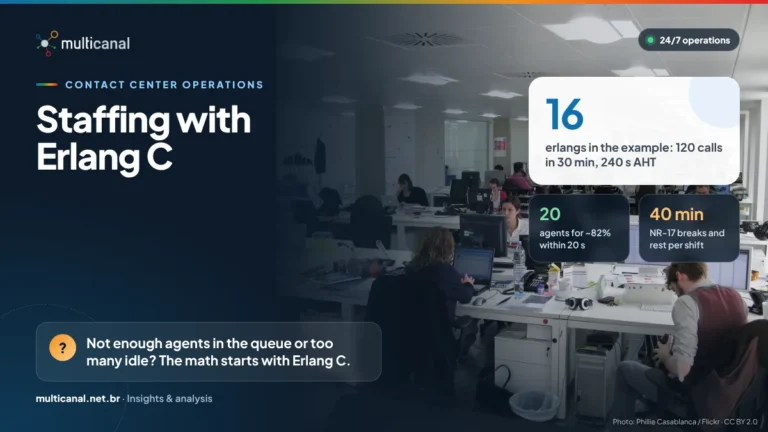
Staffing with Erlang C: how many agents your operation really needs
Erlang C turns call volume and average handling time into a number of agents. See how the calculation works, a step-by-step example and where it falls…
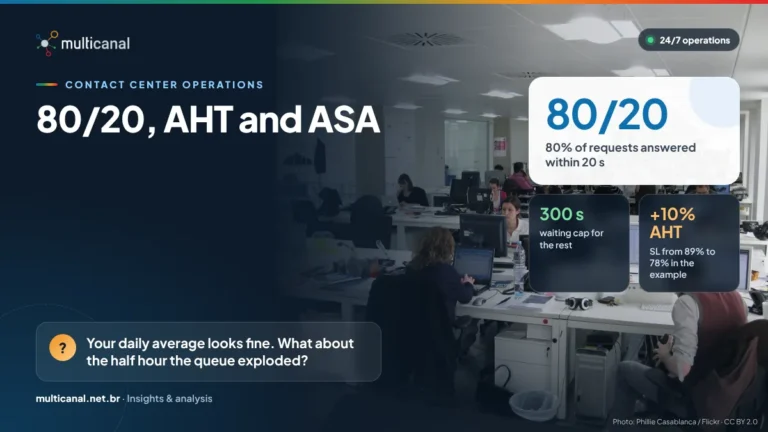
80/20 service level, AHT and ASA: how to read contact center KPIs without fooling yourself
80/20 has become law under Brazil's new SAC decree. Learn how to calculate service level, AHT and ASA, why averages hide queues and which dashboard traps…
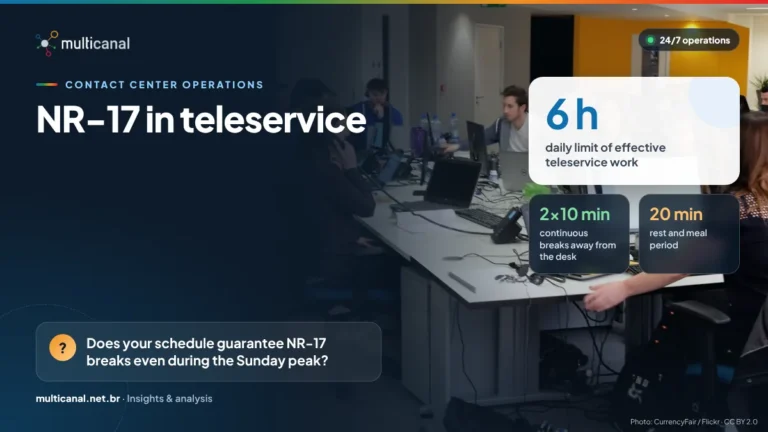
NR-17 Annex II: ergonomics, breaks and working hours in Brazil’s teleservice, item by item
A 6-hour day, two 10-minute breaks, individual headsets, adjustable furniture and limits on performance pressure: what Annex II of Brazil's NR-17 requires from teleservice.