
Customer journey insights from the contact center: speech analytics and contact reasons
Every call and chat tells why the customer reached out. See how speech analytics and good contact-reason tagging reveal journey failures — while staying compliant with the LGPD.
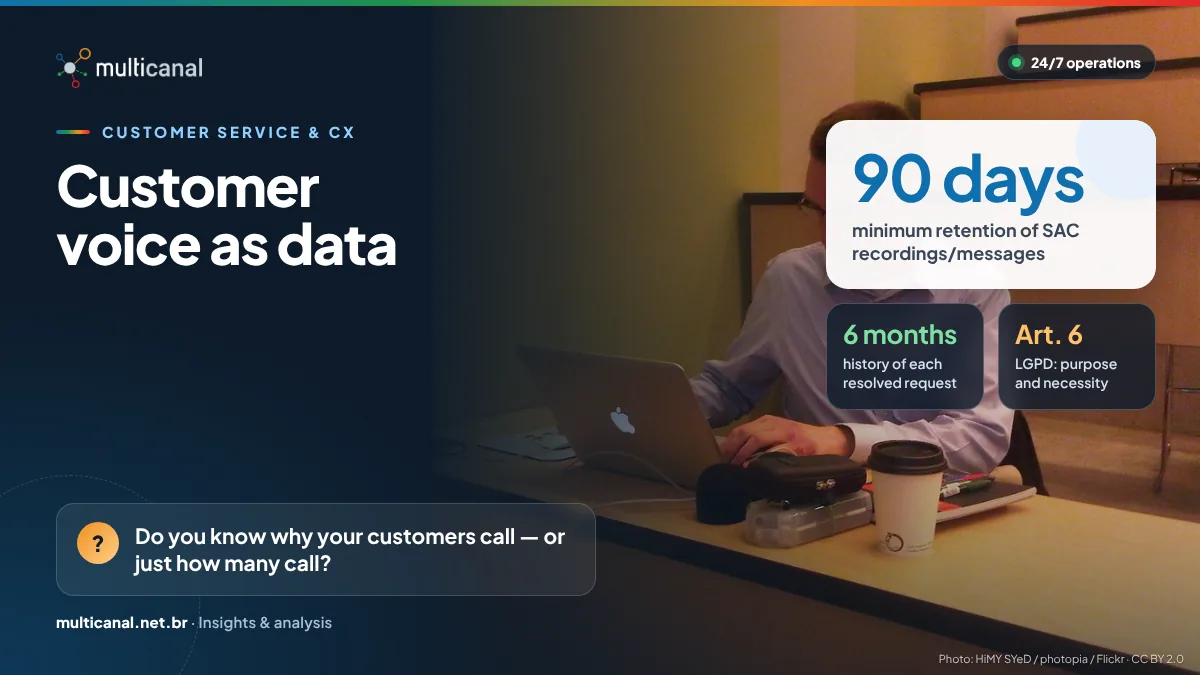
The contact center is where journey failures show up first: the bill nobody understands, the late delivery, the app that crashes. When calls and digital conversations are analysed in a structured way, these signals stop being scattered complaints and become data to fix processes — as long as the use complies with the LGPD, Brazil’s data protection law.
Contact reasons: the foundation
Before any technology, you need to know why the customer contacted the company. A lean tagging tree — reason, sub-reason and outcome — applied consistently across all channels answers simple, powerful questions: which reasons are growing fastest, which generate repeat contacts, which could be avoided with a proactive message or a process fix. Tagging with dozens of vague options, or filled in on autopilot, has the opposite effect: data nobody trusts.
What speech analytics adds
Speech analytics is the automated analysis of service recordings and texts: audio is transcribed through speech recognition and the content is examined for words, topics, silences, overtalk and signs of dissatisfaction. Used well, it:
- Classifies contact reasons across all interactions, not just the quality-monitoring sample.
- Reveals root causes that tagging misses, such as recurring mentions of the same error or of a competitor.
- Shows where service gets stuck: transfers, long silences, requests to repeat data.
- Feeds quality monitoring and coaching with real examples.
The limit: transcription makes mistakes, especially with noise and accents, and models need regular calibration and human review. Metrics derived from transcripts should be treated as trends, not as absolute truth about each interaction.
Recordings, retention and the LGPD
Brazil’s Decree 13.135/2026 requires call recordings and the content of voice or text messages exchanged through customer service (SAC) channels to be kept for at least 90 days (art. 19), and the history of each request for at least six months after resolution (art. 18, § 4, II). To reuse this material in analytics, the LGPD requires a legitimate and disclosed purpose, use of the minimum necessary and transparency (art. 6), plus security measures from the design stage (art. 46). Two points deserve attention:
- If the voice is used to identify the person, it becomes biometric data, a category of sensitive personal data (art. 5, II), with stricter rules.
- NR-17, Brazil’s ergonomics standard, only allows monitoring by listening and recording with the agent’s knowledge (Annex II, item 6.12).
Whenever possible, anonymise or pseudonymise the transcripts used in reports and restrict access to recordings to those who need them.
In 1952, Bell Labs introduced Audrey, one of the first speech recognition systems: it recognised only the digits zero to nine, spoken by a voice it had been calibrated for. The same idea, greatly evolved, is behind the transcription used in speech analytics.
References and legislation
- Decreto nº 13.135/2026 · customer service (SAC): retention of recordings/messages (art. 19) and history (art. 18) — access
- Lei nº 13.709/2018 (LGPD) · Brazil’s data protection law: principles (art. 6), sensitive data (art. 5), security (art. 46) — access
- NR-17, Anexo II · monitoring by listening and recording in teleservice (item 6.12) — access
- Computer History Museum · the story of Audrey and voice recognition — access
We recommend starting with tagging before investing in technology. Speech analytics amplifies what already exists: with well-defined reasons, it shows causes and trends; with confusing tagging, it just produces more charts.
— Multicanal Content Team · Multicanal Contact CenterHow Multicanal helps: we integrate phone and digital channels into an omnichannel operation with call recording, service history and operational reports that show why your customers get in touch.
Explore omnichannel serviceKeep reading
Brazil’s new SAC Decree (13.135/2026): what changed since 11.034 and how to adapt
In force since November 2, 2026, Decree 13.135 revoked Decree 11.034/2022, requiring human service from 8 a.m. to 8 p.m., a 20-second wait for 80% of…
FCR: why first contact resolution moves satisfaction and cost at the same time
Every repeat contact is service paid twice and a less satisfied customer. Learn how to measure FCR without distortion, what Brazil's new SAC decree requires and…
NPS, CSAT and CES: what each metric measures, when to use it and how to act on results
Three acronyms, three different questions. Learn the origin and calculation of NPS, CSAT and CES, the right moment for each survey and how to turn scores…