
LGPD in collections: legal bases, third-party contact and data minimization
Collections use personal data all the time. See which legal bases of Brazil's LGPD apply, why the debt must not be exposed to third parties and how to process only what is needed.
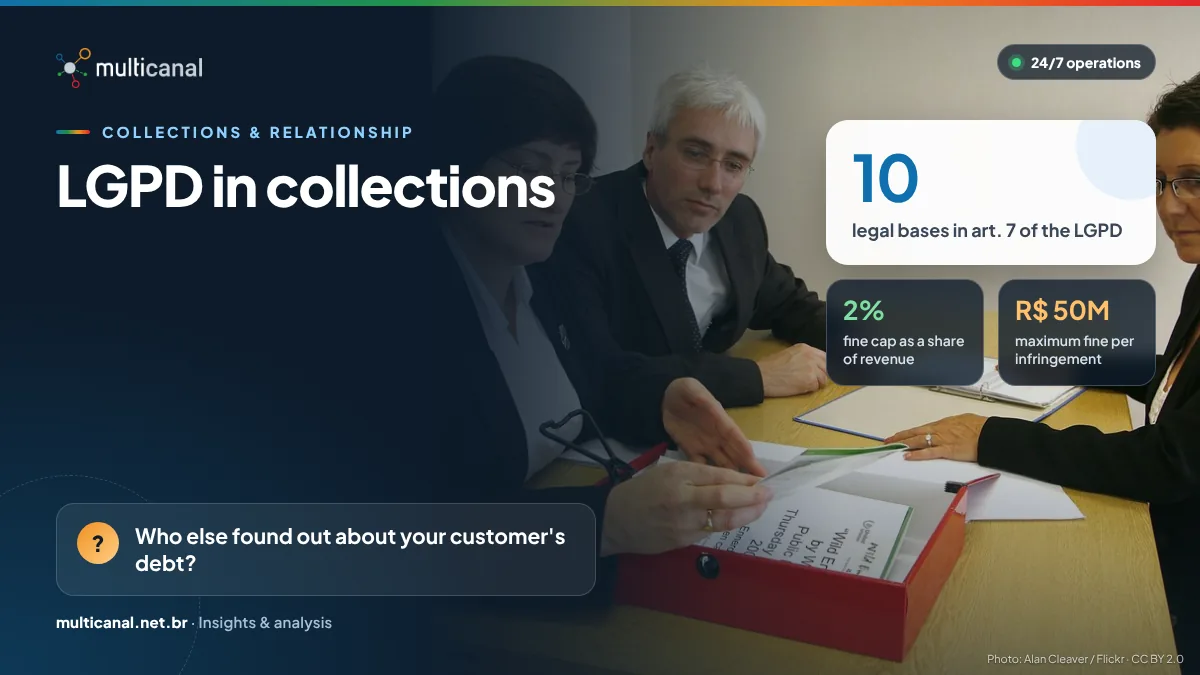
Every collection starts with personal data: name, CPF taxpayer number, phone, amount owed, payment history. Brazil’s General Data Protection Law (Lei Geral de Proteção de Dados, Law 13,709/2018) does not prevent collection, but it requires every piece of data to have a purpose, a legal basis and a limit. In a high-volume operation, a processing error is repeated at scale.
Which legal bases support collections
Art. 7 of the LGPD lists ten legal bases for processing personal data. In collections, the most common are:
- contract performance (item V): collecting what was agreed is part of the relationship with the data subject itself;
- regular exercise of rights in judicial, administrative or arbitration proceedings (item VI);
- credit protection (item X), under the applicable legislation, such as the rules on credit registries;
- legitimate interest (item IX), which requires a concrete purpose, the use of only strictly necessary data and respect for the data subject’s legitimate expectations (art. 10). The ANPD published guidance on this basis in 2024, including a balancing test template.
Consent is rarely the right basis for collecting: it can be withdrawn at any time, and the debt does not disappear because of that. What matters is choosing and documenting the basis for each purpose and keeping records of processing operations (art. 37).
Contacting third parties: the most sensitive point
Calling the debtor’s workplace, relatives or listed references is one of the riskiest practices. Besides the LGPD, which requires compatibility with the stated purpose and transparency, Brazil’s Consumer Protection Code (CDC) prohibits exposing consumers to ridicule or embarrassment (art. 42) and makes it a crime to use procedures that unjustifiably interfere with their work, rest or leisure (art. 71). Good practices:
- never reveal the existence or amount of the debt to anyone other than the data subject;
- use third-party contacts, when there is a legal basis, only to locate the data subject, without debt details;
- confirm identity before discussing the debt;
- record and honor requests not to be contacted at a given number.
Minimization and security in practice
The necessity principle (art. 6, III) limits processing to the minimum needed for the purpose. In collections, the team sees only the data it needs to negotiate; old or excessive databases are deleted; data sent to partners follows contracts and clear instructions; recordings and records have defined retention periods.
Security incidents that may pose relevant risk or harm must be reported to the National Data Protection Agency (ANPD) and to data subjects, within three business days under the agency’s regulation. Fines can reach 2% of revenue in Brazil, capped at R$ 50 million per infringement (art. 52).
The European General Data Protection Regulation (GDPR) provides six legal bases; the LGPD provides ten, including credit protection, a basis with no direct equivalent in the European list.
References and legislation
- Lei 13.709/2018 (LGPD) · arts. 6, 7, 10, 37 and 52 — access
- ANPD guidance · legal bases: legitimate interest (2024) — access
- Security incident reporting (ANPD) · deadlines and procedure — access
- Lei 8.078/1990 (CDC) · arts. 42 and 71, debt collection — access
In collections, privacy and efficiency go hand in hand: the more accurate and lean the database, the fewer wrong contacts and the lower the risk. We recommend mapping every data flow in the operation before the first call.
— Multicanal Content Team · Multicanal Contact CenterHow Multicanal helps: Multicanal follows the standards of ISO/IEC 27001 and ISO/IEC 27701, and our data protection officer can be reached at dpo@multicanal.net.br.
See LGPD and privacyKeep reading
Ethical collections: what Brazil’s Consumer Protection Code forbids in arts. 42 and 71
Embarrassing, threatening or exposing debtors is not just bad practice: it can lead to double refunds and even criminal charges. See what the CDC forbids.
Brazil’s Over-indebtedness Law: what changes in collections and debt renegotiation
Law 14,181/2021 created responsible lending rules, protected the existential minimum and opened the way to debt restructuring. See the impact on collections.
Omnichannel collections cadence: from preventive reminders to negotiation
How to build a collections cadence that combines SMS, email, WhatsApp and phone at the right time, with the right message and within Brazilian rules and…